
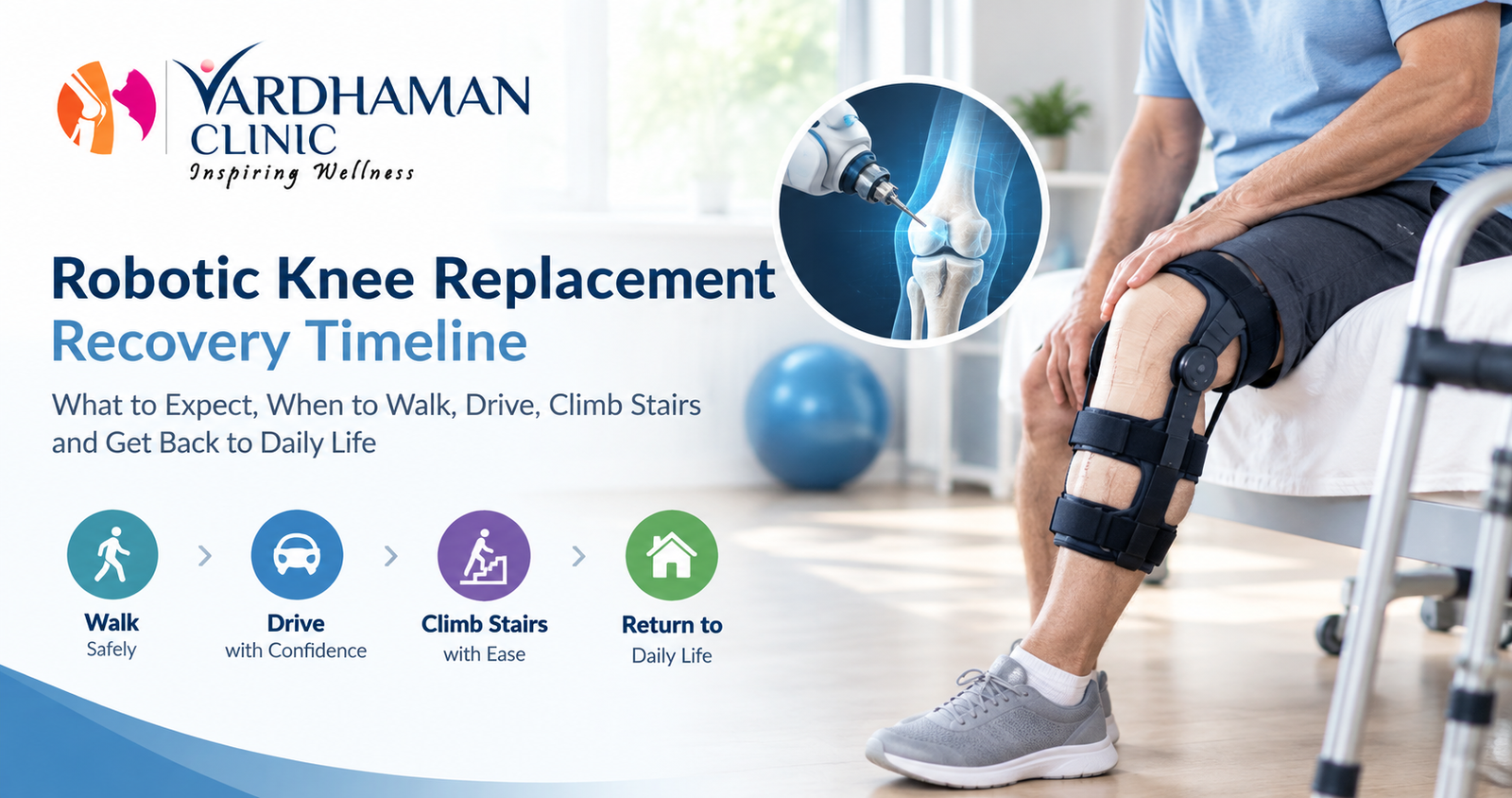
Robotic knee replacement uses computer-guided technology to help surgeons plan and position the knee implant with more precision than freehand instrumentation typically allows. But for most patients, the technology matters less than the everyday questions sitting underneath it. When can I walk without holding onto something? When can I drive again? Will stairs ever stop feeling risky?
Robotic assistance can improve implant alignment and, in some cases, make the surgical experience smoother, but it does not come with a fixed recovery clock. Robotic knee replacement recovery still depends on the person: age, fitness level, other health conditions, and how consistently the rehabilitation plan gets followed. Surgeons offering robotic total knee replacement and minimally invasive knee replacement, such as Dr. Abhay Chhallani, an orthopedic surgeon in Nerul, Navi Mumbai, generally guide patients through a similar broad recovery arc, even though the exact pace differs from person to person. What follows is a general picture of how recovery tends to unfold.
How Long Does Robotic Knee Replacement Recovery Take?
For most patients, walking independently, managing daily tasks, and getting back to most normal activities takes roughly three to six months. Full strength and stamina can keep improving for up to a year in some cases.
Robotic assistance helps with surgical precision, but it does not speed up biology. Bone, soft tissue, and muscle still need time to heal no matter how accurately the implant was positioned. Two patients who have the same robotic total knee replacement, with the same surgeon, can still end up on noticeably different timelines depending on where they started.
Several factors shape robotic knee replacement recovery time, including:
- Age and general health before surgery
- Muscle strength and mobility going into the procedure
- Body weight
- Presence of other conditions such as diabetes or cardiovascular disease
- How early and consistently physical therapy begins
- Pain tolerance and pain management
- Individual healing response, which varies from person to person
Robotic Knee Replacement Recovery Timeline
Every patient heals at a different pace, but recovery generally follows a broad pattern.
First few days Most patients stand and take a few assisted steps within 24 hours of surgery, often with a walker. Pain and swelling tend to be at their worst here and are managed with prescribed medication, ice, and elevation. Hospital stays are usually short, sometimes one or two nights, occasionally same-day, especially with minimally invasive total knee replacement techniques.
Week 1 to 2 Walking distances around the house increase gradually. Swelling and stiffness are still there but should start easing with consistent icing, elevation, and prescribed exercises. Physical therapy usually starts in this window, mostly gentle range-of-motion work.
Weeks 3 to 6 Many patients move from a walker to a cane, and some drop the walking aid altogether depending on strength and balance. Short outdoor walks get more manageable. Light tasks like cooking or a quick errand may resume, though standing for long periods can still bring on fatigue or swelling.
Weeks 6 to 12 Strength and range of motion keep building. Longer walks and lighter household chores start to feel doable. This is usually when therapy shifts toward more targeted strengthening work.
3 to 6 months and beyond Most patients notice real improvement in walking, stairs, and general mobility by this point. Some return to low-impact activities like swimming or cycling once the surgeon approves. Full strength and stamina can keep improving for up to a year.
When Can You Walk After Robotic Knee Replacement?
Walking usually starts the same day or the day after surgery, with a physiotherapist or nurse close by. A walker is common in the early days and weeks, giving the knee something to lean on while it adjusts to bearing weight again.
As strength and confidence build, most patients move from a walker to a cane and eventually walk unassisted, though the exact timing varies quite a bit. Knee replacement walking recovery tends to be gradual rather than sudden: a handful of supervised steps in week one, short walks around the house by week two, and longer walks outdoors somewhere around weeks four to six for many patients.
Things that affect how quickly walking improves include:
- Muscle strength before surgery
- How closely rehabilitation exercises are followed
- Pain and swelling levels
- Balance and coordination
- Any other joint or mobility issues
Walking aids should be used exactly as instructed, and it’s worth resisting the urge to move faster than the body and physiotherapist recommend.
When Can You Drive After Knee Replacement?
There’s no single date that works for everyone here. Driving needs quick reaction times, comfortable pedal control, and enough movement in the operated leg to react without hesitation, and all of that takes time to come back.
A few things generally need to be in place before driving makes sense:
- Adequate strength and control in the operated leg
- Enough knee bend to sit comfortably and work the pedals
- Little to no reliance on strong pain medication, since it can dull alertness
- Confidence in being able to perform an emergency stop
Because these factors are different for every patient, it’s best to wait for clearance from the orthopedic surgeon before driving again. Getting behind the wheel too early, even if the knee “feels fine,” can put the patient and everyone else on the road at risk.
When Can You Climb Stairs After Knee Replacement?
Stairs often show up early in physical therapy, sometimes within the first week, though usually under supervision at first.
A safer approach in the early weeks looks like this:
- Lead with the non-operated leg going up
- Lead with the operated leg going down
- Keep a hand on the rail
- Use a cane or walker on stairs if the physiotherapist recommends it
As strength, balance, and confidence build over the following weeks, stairs stop feeling like such a project. It’s worth avoiding stairs without a handrail or support until the physiotherapist gives the go-ahead.
Physical Therapy After Robotic Knee Replacement
Physical therapy does a lot of the heavy lifting in recovery. Surgery fixes the joint, but therapy is what retrains the muscles, tendons, and nerves around it to work together again.
A typical rehabilitation program focuses on:
- Restoring range of motion in the knee
- Rebuilding strength in the thigh and surrounding muscles
- Improving balance and coordination
- Supporting a normal, steady walking pattern
- Gradually restoring functional mobility for daily tasks
Skipping sessions or rushing through them can slow things down and leave the knee stiffer or weaker later on. Patients who stay consistent with both their sessions and home exercises tend to end up with better long-term outcomes.
Robotic Knee Replacement Rehabilitation Exercises
Exercises are usually introduced in stages, starting gentle and building up as healing allows. Ones commonly prescribed include:
- Ankle pumps: support circulation, especially in the early days
- Quadriceps sets: activate thigh muscles without much knee movement
- Heel slides: gently work on knee bending
- Straight-leg raises: build thigh strength while protecting the joint
- Knee-bending and straightening exercises: restore range of motion
- Walking exercises: rebuild a steady gait
- Progressive strengthening exercises: added later to build lasting muscle support
These should only be done as instructed by the treating surgeon or physiotherapist. The right exercises, reps, and progression depend on individual healing and what the surgery found.
What Factors Affect Knee Replacement Recovery Time?
Recovery speed comes down to a mix of things, including:
- Age: younger patients sometimes hit certain milestones faster, though not always
- Overall fitness: better baseline conditioning tends to support smoother rehab
- Muscle strength: stronger surrounding muscles help stabilize the new joint
- Pre-surgery mobility: patients who moved well before surgery often adapt more easily afterward
- Weight: extra weight adds stress to the healing joint
- Other health conditions: things like diabetes or heart disease can slow healing
- Pain and swelling levels: more of either can slow the pace of rehab
- Physical therapy adherence: sticking with it consistently makes a real difference
- Individual healing: every body responds to surgery a bit differently
Tips for a Safe Recovery After Robotic Knee Replacement
- Stick closely to the rehabilitation plan from the surgical and physiotherapy team
- Increase activity gradually instead of pushing too hard too soon
- Do the prescribed exercises consistently, even on low-motivation days
- Use walking aids correctly and only cut back on them when advised
- Manage swelling with rest, elevation, and ice as recommended
- Show up to follow-up appointments, even when recovery feels on track
- Hold off on driving, strenuous activity, or high-impact movement until cleared
When Should You Contact Your Orthopedic Surgeon?
Some discomfort and swelling are normal after surgery, but a few symptoms call for prompt attention. Contact the orthopedic surgeon if any of these show up:
- Pain that’s getting worse instead of better
- Increasing redness, warmth, or swelling around the knee
- Fever
- Drainage or discharge from the surgical wound
- Significant calf pain or swelling
- Sudden shortness of breath or chest pain
These can sometimes point to infection or a blood clot and shouldn’t be brushed off.
FAQs
1. How long does robotic knee replacement recovery take? Most patients see significant improvement within three to six months, though full strength and stamina can keep improving for up to a year.
2. When can you walk normally after robotic knee replacement? Many patients are walking without an aid somewhere between six and twelve weeks, though it depends on individual healing and rehab progress.
3. When can you drive after robotic knee replacement? Usually once the surgeon clears it, which generally means pain medication has stopped and the operated leg has enough strength and control. Timing varies by patient.
4. When can you climb stairs after knee replacement? Often introduced within the first week using proper technique and support, getting easier as strength builds over the following weeks.
5. How long is physical therapy needed after knee replacement? Structured therapy commonly runs several weeks to a few months, with home exercises sometimes continuing longer as advised.
6. What exercises are recommended after robotic knee replacement? Ankle pumps, quadriceps sets, heel slides, straight-leg raises, and progressive strengthening exercises are common, all guided by a physiotherapist.
7. Is recovery faster after robotic knee replacement? Robotic assistance can support more precise implant positioning, but it doesn’t guarantee faster healing. That still comes down to the individual patient.
8. When can patients return to normal daily activities? Light daily activities often resume within a few weeks, while more demanding tasks typically come back gradually over three to six months.
Conclusion
Recovery from robotic knee replacement depends on more than the surgery itself. It comes down to overall health, how consistently physical therapy gets followed, and how closely the personalized recovery plan is stuck to. General timelines are useful as a rough guide, but every patient heals at their own pace. Patients in Nerul, Panvel, and Navi Mumbai considering robotic total knee replacement or minimally invasive knee replacement can discuss a personalized recovery plan with an experienced orthopedic surgeon like Dr. Abhay Chhallani. Staying in close touch with the surgeon and physiotherapist, and following their specific guidance on walking, driving, stairs, and daily activities, remains the safest way through recovery.