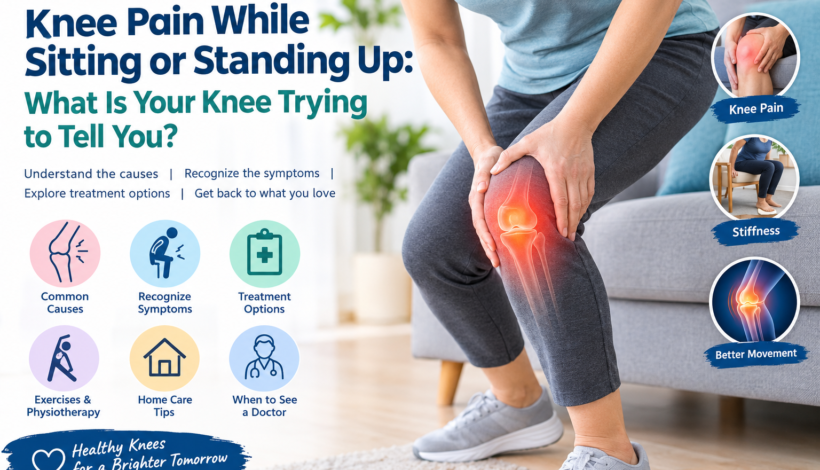
Think about the last time you sat through a long meeting or a slow train ride. The moment you stood up, your knee felt stiff and a bit unsure of itself, almost as if it needed a minute before it agreed to carry you.
That nagging knee pain while sitting is something doctors and physiotherapists hear about almost every day. It is far more common than most people assume.
Sometimes the cause is nothing serious, just a joint that did not get enough movement. At other times it is the first quiet sign that something inside the knee needs attention.
A lot of people notice it as knee pain when standing up from a low sofa, an auto seat, or the floor during a family function.
Because the ache usually fades after a few steps, it is easy to ignore and move on with the day.
But knee pain when getting up that shows up again and again is worth listening to. Early attention often keeps the treatment simple.
In this guide we will go through what may be causing the pain, which symptoms matter, and what you can do about it. It is general information meant to help you understand your knee better, and it cannot replace a proper check-up.
Why Does Knee Pain While Sitting Happen?
Your knee works harder than most joints. It carries your body weight, bends and straightens thousands of times a day, and absorbs shock with every step.
After a long stretch in a chair, knee pain after sitting tends to be at its worst in the first few steps.
When you sit, the knee stays bent and the joint gets less of the gentle pumping that walking gives it. The tissues cool and tighten, and the joint needs a little time to loosen up again.
Pressure behind the kneecap adds to this. If you sit with bent knees for hours, knee pain after sitting for long time becomes very common, even in people who have never hurt the knee.
Muscle strength matters a lot too. When the thigh and hip muscles are weak, the knee ends up taking more load than it should.
That is often why some people notice knee pain while standing in a queue, at the kitchen counter, or at a bus stop.
Hips and feet play a role as well. Tight hips or flat, unsupported feet can change how force travels up to the knee.
On top of that, a low seat makes things harder, and knee pain when rising from chair can show up even on days the knee otherwise feels fine.
Many people also say the joint feels worse on cold mornings or after a long, tiring day.
Some describe knee stiffness after sitting that takes a minute or two to wear off before things feel normal again.
A mild stiffness that passes quickly is usually not a big worry.
However, knee pain and stiffness that keep coming back, or slowly worsen over weeks, deserve a closer look.
Common Reasons Behind Knee Discomfort
There are many causes of knee pain, and it is hard to guess the real reason from symptoms alone. A proper examination, and sometimes a scan, is what shows what is actually going on. Here are the more common possibilities.
Patellofemoral Pain Syndrome
This is pain around or behind the kneecap. It often shows up when you climb stairs, squat, or stand up from a low seat.
Knee Osteoarthritis
Osteoarthritis is a wear-related change in the joint cartilage. It usually develops slowly and becomes more common with age, though an old injury can also set it off.
Muscle Weakness and Movement Strain
Weak thigh or hip muscles, tight hamstrings, or a sudden jump in activity can all put extra stress on the knee. Even the way you walk or sit can add strain over time.
Tendon Irritation
The tendons around the knee can become irritated from overuse, especially if you recently started running, cycling, or climbing more stairs than usual.
Inflammation or Swelling
Inflammation makes a joint warm, puffy, and tender. It can follow overuse, an injury, or an underlying joint condition.
Previous Knee Injuries
An old ligament, meniscus, or cartilage injury can leave the knee sensitive years later. Many people forget a sports injury from their twenties until the knee starts complaining in their forties.
None of these should be treated as a self-diagnosis. Two people can have similar pain from completely different reasons.
Symptoms You Should Not Ignore
Knowing the usual knee pain symptoms helps you decide when to take things seriously. These are the ones people mention most often:
- A dull ache or sharp pain when bending the knee
- Stiffness after rest, especially in the morning or after sitting
- Tenderness when you press around the joint
- Difficulty standing up, or trouble with stairs
- A feeling that the knee is weak or may give way
- Reduced range of motion, where the knee does not bend or straighten fully
- Clicking or grinding that comes with pain
A knee that feels warm, looks puffy, and is sore to touch is showing classic knee inflammation symptoms.
One simple trick is to compare both knees side by side. A visible difference can tell you a lot.
Knee swelling symptoms can include a visibly larger knee, a feeling of fullness, or trouble bending the joint fully.
If any of this lasts more than a couple of weeks, keeps returning, or is getting worse, please get the knee examined.
Is It Arthritis or Osteoarthritis of the Knee?
People often use these two words as if they mean the same thing, but there is a small difference. Arthritis is a broad term covering many types of joint inflammation and joint disease. Osteoarthritis is one specific type, and it is the one most often linked with the knee.
Common knee arthritis symptoms include pain that worsens with movement, stiffness after rest, occasional swelling, and a slow drop in how easily the knee moves.
Some people also feel that the knee is less steady than before.
With wear-related changes, the usual osteoarthritis knee symptoms include short morning stiffness, pain on stairs or uneven ground, and discomfort after sitting for a while.
Over time, even lighter activity may leave the knee feeling sore.
How Is It Treated?
Knee arthritis treatment depends on the type of arthritis, how advanced it is, and how much it affects your daily life.
Every joint is different, so a doctor will plan the next step only after examining you and reviewing any tests.
For osteoarthritis knee treatment, doctors usually begin with conservative options such as activity changes, weight management when appropriate, strengthening work, physiotherapy, and medicines when needed.
If these steps are not enough, your doctor will explain the next option after a proper evaluation.
Understanding Pain Around the Kneecap
If your pain sits mostly at the front of the knee, around or behind the kneecap, patellofemoral pain may be one possibility. It tends to worsen with long sitting, squatting, running downhill, and standing up from a chair.
The kneecap glides in a groove at the end of the thigh bone. When it is under extra pressure, that glide can become uncomfortable.
Typical patellofemoral pain symptoms include a dull ache at the front of the knee, discomfort after sitting with bent knees, and sometimes a grinding or clicking feeling.
The pain often feels better when you rest the knee in a straighter position for a while.
Patellofemoral pain treatment usually focuses on why the kneecap is under pressure. That can mean strengthening the hip and thigh muscles, improving flexibility, adjusting activity levels, and correcting movement habits.
A physiotherapist or doctor can assess this properly. No one can promise a quick cure, but many people improve steadily with the right guidance and some patience.
Your Treatment Options Explained
There is no single answer here. A doctor will usually look at your history, examine the knee, and sometimes suggest an X-ray or MRI before deciding the next step.
The right knee pain treatment depends on what is causing the problem and how severe it is.
Treatment is never one-size-fits-all. What suits one person may not suit another, even when the pain feels the same.
Among the common knee pain treatment options, a doctor may choose from the following after assessment:
- Activity modification and pacing: cutting back on movements that trigger pain while staying gently active.
- Strengthening exercises: targeted work to support the joint.
- Physiotherapy: guided rehabilitation to improve strength, movement, and balance.
- Ice or heat: ice may help a sore, irritated joint, while heat can ease stiffness. The right choice depends on your situation.
- Medical assessment and medication: a doctor may prescribe medicines when needed. Please do not self-medicate for long periods.
- Treatment of the underlying condition: if arthritis, a tendon problem, or something else is behind the pain, that needs to be addressed directly.
For knee inflammation treatment, doctors usually aim to calm the irritation first and then work on the cause.
What worked for a neighbour or relative may not suit your knee, so please avoid copying someone else’s routine.
Knee swelling treatment also depends on the reason for the swelling. Swelling after a minor strain is very different from swelling linked to a joint condition or an infection.
That is exactly why a proper check matters.
Simple Ways to Ease Discomfort at Home
For mild discomfort, a few small habits can bring some knee pain relief. These are general suggestions, and they work best when the pain is mild and there has been no recent injury.
- Change position often: stand up, stretch, and walk around every 30 to 45 minutes instead of staying bent in one position.
- Avoid staying still for too long: gentle movement keeps the joint from getting stiff.
- Wear supportive footwear: shoes with good cushioning reduce stress on your knees.
- Ease back into activity: if you have been inactive, increase walking slowly instead of jumping into a heavy routine.
A few gentle warm-up movements before you get up, like straightening and bending the knee, can make a real difference.
These habits also work as basic knee stiffness treatment that you can start at home, especially when stiffness shows up mostly after sitting.
Home care has limits, though. Severe pain, new or significant swelling, or being unable to put weight on the leg should never be managed with home remedies alone. Those signs need a doctor’s opinion.
Can Exercise and Physiotherapy Help?
For many people, yes. A guided plan can improve strength, flexibility, balance, and everyday comfort.
Regular knee pain exercises also take some of the load off the joint, which is why they are often advised as a daily habit and not a one-time effort.
A plan built around your own knee works far better than a generic routine from the internet.
Knee pain physiotherapy gives you that structured path, with exercises adjusted as you improve.
A qualified professional may suggest options such as:
- Quadriceps strengthening
- Straight-leg raises
- Gentle range-of-motion movements
- Hamstring and calf stretches
- Hip strengthening and balance work
The key point is that exercises should match the cause of your pain. Something that helps one person may aggravate another person’s knee, so if an exercise increases your pain, stop and let your physiotherapist or doctor adjust the plan.
Consistency matters more than intensity. A few minutes of the right movement most days usually does more than one hard session followed by days of soreness.
Non-Surgical and Orthopedic Care
The good news is that many knee problems can be managed without surgery, especially when they are caught early. Non surgical knee treatment may include rehabilitation, lifestyle adjustments, supportive devices, and medicines, depending on what the doctor finds.
When pain keeps coming back or daily life becomes difficult, the first step is a proper examination, a review of your history, and imaging if needed.
Good orthopedic treatment for knee pain starts with a clear diagnosis, and only then moves to a plan that fits you.
No honest doctor can guarantee results before examining you. Any recommendation for a specific procedure, including surgery, should come only after a clinical evaluation and an open conversation about benefits, risks, and alternatives.
When Is It Time to See a Doctor?
Not every twinge needs a knee pain specialist, but it is a good idea to book a visit if you notice any of these:
- Pain that keeps coming back or does not improve after a few weeks
- Stiffness that lasts or is getting worse
- Swelling that does not settle
- A feeling that the knee is unstable or giving way
- Trouble with everyday tasks such as climbing stairs, walking, or getting up from a chair
Some signs need urgent attention. If the knee is hot, red, and swollen, especially with fever, severe pain, a major injury, visible deformity, or an inability to bear weight, please do not wait.
Frequently Asked Questions (FAQs)
1. Why does my knee hurt when I stand up after sitting?
The joint has been bent for a while, and the muscles and tissues around it have tightened. Standing up loads the knee again before it has warmed up.
This kind of knee pain after sitting is often just stiffness when it settles quickly. If it is frequent or getting worse, get it checked.
2. What causes knee pain after sitting for a long time?
Usually it is a mix of joint stiffness, pressure behind the kneecap, and weak thigh muscles. Conditions like patellofemoral pain or osteoarthritis can also play a part.
Once the reason is clear, a plan for non surgical knee treatment can be built around it instead of guessing.
3. Is knee stiffness after sitting a sign of arthritis?
It can be, but not always. Muscle tightness and simple inactivity cause it too.
If the stiffness is frequent, lasts longer, or comes with swelling, it may be one of the knee arthritis symptoms that need a doctor’s opinion.
4. Can patellofemoral pain cause discomfort when getting up from a chair?
Yes. Pain around the kneecap often shows up when you sit with bent knees for a long time and then stand.
A proper patellofemoral pain treatment plan usually begins with an assessment of why the kneecap is under pressure.
5. Which exercises may help with knee pain and stiffness?
Gentle quadriceps strengthening, straight-leg raises, and range-of-motion movements are commonly used. The right choice depends on your diagnosis, so check with a physiotherapist first.
Along with simple warm-ups, they can act as practical knee stiffness treatment in daily life.
6. Can physiotherapy help relieve knee pain?
For many people it can. Physiotherapy aims to build strength, improve movement, and correct habits that overload the joint.
When followed regularly, it can bring meaningful knee pain relief, although results vary from person to person.
7. How is osteoarthritis of the knee treated?
Osteoarthritis knee treatment usually starts with conservative care such as activity changes, exercise, physiotherapy, weight management when needed, and medicines prescribed by a doctor.
The plan depends on how far the condition has progressed and how it affects your life.
8. When should I see an orthopedic specialist for knee pain?
See one if pain persists, swelling does not go away, the knee feels unstable, or daily activities are getting harder.
Good orthopedic treatment for knee pain begins with an examination and, if needed, imaging. Seek urgent care for a hot, red, swollen knee with fever, severe pain, or an inability to bear weight.
Conclusion
Knee pain while sitting or standing up may feel like a small annoyance, but it should not be ignored when it is persistent or getting worse. Sometimes it is simple stiffness. Sometimes it is a sign that the joint needs care.
Pay attention to what triggers your discomfort and avoid movements that clearly aggravate it. Keep your body gently active, and do not let ongoing knee pain and stiffness become your normal.
Most importantly, do not guess. A proper diagnosis from a qualified orthopedic professional or a physiotherapist is the first step towards the right treatment. The earlier you understand what your knee is trying to tell you, the easier it usually is to look after it.