
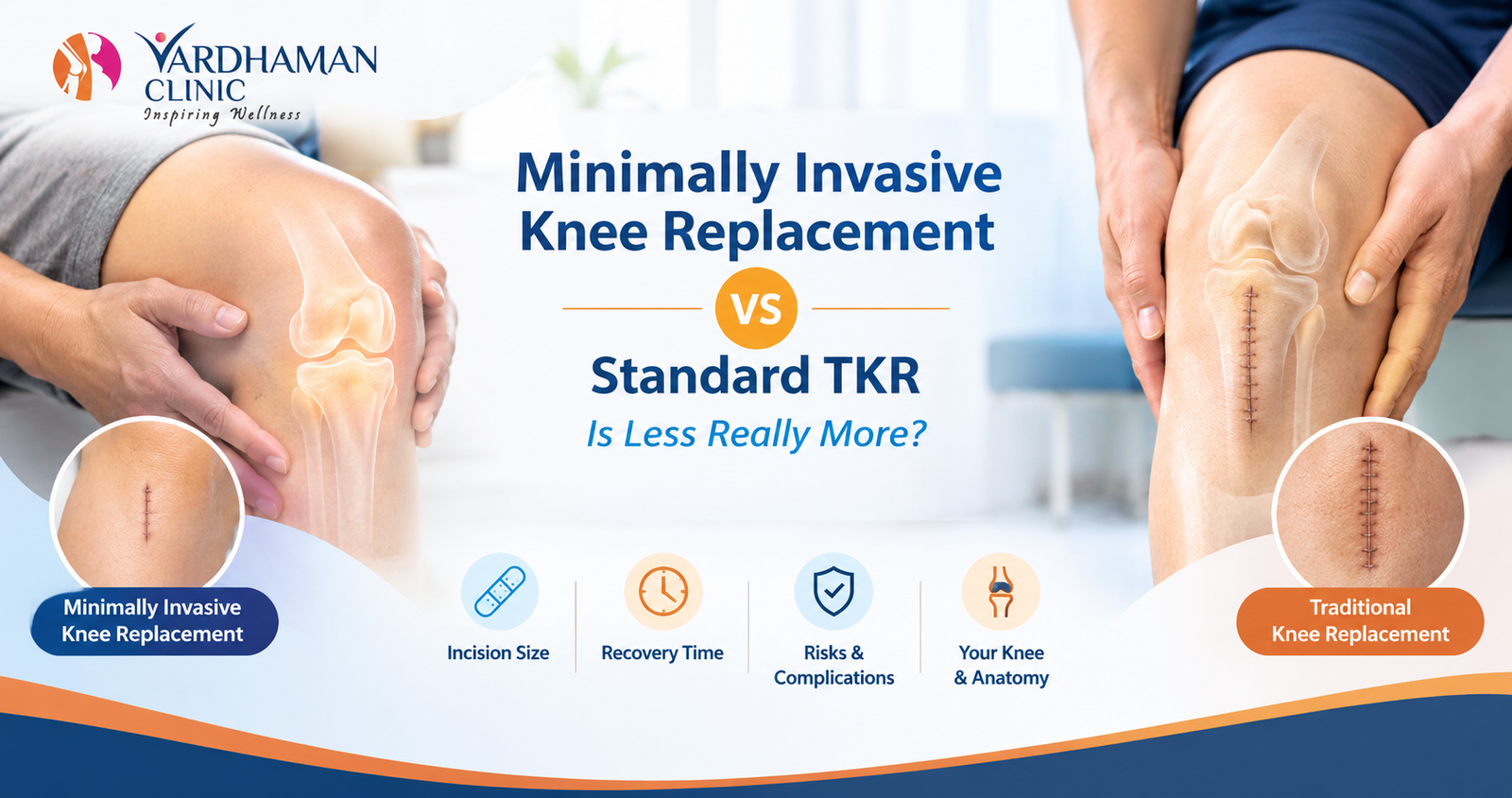
If you’ve started researching knee replacement surgery, chances are you’ve run into two terms that seem to compete with each other: “minimally invasive total knee replacement” and good old “traditional knee replacement.” And it’s easy to see why the minimally invasive option catches your attention first: a smaller cut just sounds better. Less trauma, less pain, back on your feet sooner. Who wouldn’t want that?
But here’s the more honest answer: it depends on you, specifically. Both minimally invasive knee replacement and standard total knee replacement (TKR) are legitimate, well-established ways to treat advanced knee arthritis. Neither one is the “upgraded” version of the other. Which one makes sense for you comes down to your anatomy, how far your arthritis has progressed, and, just as importantly, your surgeon’s training and comfort with each technique. Let’s walk through how the two actually compare, what the research really shows about recovery, and how to think through the decision with your surgeon.
What Is Minimally Invasive Knee Replacement?
At its core, minimally invasive knee surgery is still a total knee arthroplasty (TKA); it’s just performed through a smaller incision, with an effort to disturb less of the muscle and soft tissue around the joint. Where a traditional approach cuts through the quadriceps tendon directly, minimally invasive techniques tend to work around or between muscle fibers instead, trying to leave more of that tissue undisturbed.
One thing worth clearing up right away: “minimally invasive” describes the surgical approach and the size of the cut, not a different implant or a shortcut version of the procedure. The surgeon still has to get the alignment, balance, and implant fit exactly right; that part of the job doesn’t get any easier just because the incision is smaller.
What Is Standard or Traditional Total Knee Replacement?
Traditional knee replacement has been the workhorse of joint replacement for decades, and it’s still the most studied, most widely performed version of the surgery. The incision is longer, which gives the surgeon a much wider, more direct view into the joint, something that really matters in more complicated cases, like significant deformity, longstanding stiffness, or a knee that’s already been operated on before.
That extra visibility isn’t just for the surgeon’s convenience. It supports more precise implant positioning, which is one of the biggest factors in how long a knee replacement lasts and how well it performs over the years.
Minimally Invasive vs Traditional Knee Replacement: Key Differences
Incision Size
Knee replacement incision size is the difference everyone notices first. Minimally invasive procedures use a shorter incision; traditional TKR uses a longer one to give the surgeon full visibility of the joint. But here’s the catch: incision length tells you almost nothing about how well the knee heals on the inside.
Knee Anatomy and Arthritis Severity
Every knee is a little different, and that’s exactly why knee anatomy plays such a big role in which technique makes sense. A knee with fairly typical alignment and mild-to-moderate wear gives a surgeon more room to work with a smaller incision. But once knee arthritis has progressed further, with significant bone loss, ligament imbalance, or a joint that’s stiff and scarred from a previous surgery, the wider view that traditional TKR provides often becomes the safer, more practical choice. In short, the difference isn’t just about the incision; it’s about how much your particular knee anatomy and arthritis severity actually allow for.
Tissue and Muscle Handling
Minimally invasive approaches are built around disturbing the quadriceps muscle and tendon as little as possible. Traditional TKR opens the joint capsule and muscle layer more fully, which means more handling of soft tissue, but in exchange, a much clearer view of everything the surgeon is working on.
Pain and Blood Loss
Some patients who go the minimally invasive route report somewhat lower knee replacement pain in those first few days, and a handful of studies have pointed to modestly lower blood loss in certain cases. That said, don’t read too much into this: results vary a lot from person to person, and pain levels have just as much to do with anesthesia choices and pain management plans as they do with the surgical technique itself.
Hospital Stay
How long you stay in the hospital has more to do with your age, any existing health conditions, and how quickly you get moving again than with your incision size. Minimally invasive cases sometimes come with shorter stays, but that’s far from guaranteed for every patient.
Early Mobility
Less disturbance to the muscle can mean less discomfort right out of the gate, which is why some patients find it a little easier to start moving after minimally invasive surgery. Still, the real driver of getting your mobility back is structured physiotherapy; that holds true no matter which technique was used.
Recovery and Rehabilitation
Whichever technique you have, the rehab journey looks pretty similar. Neither approach lets you skip physical therapy, gradual strengthening, or a proper knee replacement rehabilitation program. There’s no shortcut around that part.
Is Minimally Invasive Knee Replacement Recovery Really Faster?
This is probably the question we hear most often, and it deserves a straight answer: a smaller incision doesn’t automatically translate into a faster or better recovery. Your actual TKR recovery time hinges on things like your bone quality, muscle strength, weight, activity level, how consistently you show up for physiotherapy, and any underlying health conditions, all of which matter far more than how big or small the cut was.
Research comparing minimally invasive knee replacement recovery with traditional TKR recovery bears this out, though the results are mixed. Some studies do show slightly quicker early mobilization with minimally invasive techniques. But once you get a few months out, the longer-term outcomes, knee function, implant stability, how satisfied patients feel, tend to even out between the two approaches. In other words, the surgical technique matters most in the early weeks; after that, it’s really about the quality of the surgery and the effort you put into rehab.
Benefits of Minimally Invasive Knee Replacement
Some of the potential minimally invasive knee replacement benefits reported by patients and studies include:
A smaller, less noticeable scar
Less soft-tissue trauma right after surgery
Possibly quicker early mobility, for the right patients
Potentially less blood loss in the short term
Worth repeating: these are potential benefits, not guarantees. They won’t apply the same way to every patient or every case.
Risks and Limitations of Minimally Invasive TKR
Understanding the minimally invasive knee replacement risks is just as important as knowing the upsides. Real limitations include:
The surgeon has a narrower view of the joint during the operation, which can make getting the implant alignment exactly right more technically demanding
There’s a steeper learning curve involved, so outcomes can vary depending on how much experience the surgeon has with this specific approach
Not everyone is a good candidate. If you have significant deformity, are dealing with obesity, have had prior knee surgery, or have a very stiff joint, the traditional approach may actually serve you better
There isn’t strong long-term evidence showing that implants last meaningfully longer with one technique over the other
Choosing your surgical approach based on incision size alone, without weighing these factors, just isn’t a sound way to make this decision.
What Is the Typical Knee Replacement Recovery Time?
Regardless of which technique you have, knee replacement surgery recovery tends to follow a similar broad arc:
First 1–2 weeks: Wound healing, pain management, and gentle movement, often with a walker or crutches for support.
3–6 weeks: Walking farther, working on bending the knee, and for many patients, weaning off walking aids.
6–12 weeks: Continued strengthening, better range of motion, and a return to most everyday activities.
3–12 months: Ongoing gains in strength and stamina, with most patients settling into a stable, comfortable level of function by the end of this window.
These are general guidelines, not a promise. Actual total knee replacement recovery varies by individual, and your surgeon can give you a much more personalized picture based on your specific case.
Knee Replacement Rehabilitation: What Patients Should Expect
Here’s a bit of a spoiler for the whole article: successful knee replacement rehabilitation depends far more on how consistent you are than on which surgical technique you had. Expect:
Supervised physiotherapy focused on range of motion and strength
A gradual shift from assisted walking to moving on your own
Home exercises to keep up your progress between sessions
Follow-up visits to check on healing and how the implant is functioning
Some swelling and discomfort in the early weeks: this is normal, and it eases as you keep moving
Patience and showing up for your physiotherapy sessions will do more for your final outcome than the surgical approach ever will.
Minimally Invasive Knee Replacement vs Hip Replacement
Minimally invasive” isn’t just a knee thing: it’s just as established a hip pain treatment option for hip replacement, though the techniques and trade-offs look different between the two joints.
In minimally invasive hip replacement, surgeons often work between the natural gaps in muscle groups (what’s called an internervous plane), which in some cases allows for even less muscle cutting than minimally invasive knee techniques can manage, largely because the knee’s muscles are more central to weight-bearing and harder to work around. Compared to traditional hip replacement surgery, minimally invasive hip approaches have also been studied and adopted more widely than their knee counterparts, in part because hip anatomy simply lends itself better to smaller incisions.
As with the knee, hip replacement recovery time comes down more to your individual health and how well you stick with rehab than to incision size. That said, hip replacement surgery recovery and minimally invasive hip replacement recovery both tend to involve a shorter early mobilization phase than knee surgery, since the hip isn’t as directly involved in the bending motions you use throughout the day. Still, the same rule applies here as with the knee: hip replacement surgery options should be chosen around your anatomy and needs, not around scar size.
Which Knee Replacement Technique Is Best?
Honestly, there’s no universal answer to what makes the best knee replacement technique. It comes down to a mix of factors specific to you
Your anatomy:
Deformity, bone quality, and the condition of your soft tissue all affect which approach is even feasible.
How advanced your arthritis is:
More complex cases often need the wider visualization that traditional TKR provides.
Your surgeon’s experience:
Minimally invasive techniques take specific training, and a surgeon’s comfort level with a given approach genuinely matters.
Implant type and design:
Some implants pair better with one surgical approach than the other.
Your overall health:
Things like obesity, diabetes, or previous surgeries can shift which technique is safer for you.
Your goals and lifestyle:
How active you want to be and what you’re hoping to get out of the surgery are part of this conversation too.
The most reliable way to land on the right answer is a thorough evaluation and a candid conversation with an experienced orthopedic surgeon, not picking based on incision size.
Frequently Asked Questions
Is minimally invasive knee replacement better than traditional TKR?
Neither one wins outright. Each has its own strengths and limits, and which one is right for you depends on your specific condition and your surgeon’s expertise.
Is recovery faster after minimally invasive knee replacement?
Sometimes early mobilization is a bit quicker, but your overall recovery time depends on far more than the surgical technique, and long-term outcomes tend to look similar either way.
Does minimally invasive knee replacement cause less pain?
Some patients report modestly less pain in the first few days, but this varies from person to person and depends heavily on pain management protocols too.
How big is the incision in minimally invasive knee replacement?
It’s generally shorter than a traditional incision, though the exact length depends on the surgeon’s technique and your own anatomy.
What is the recovery time after total knee replacement?
Most patients see steady progress over 3 to 12 months: early movement starts within the first couple of weeks, with strengthening continuing for months after.
Who may be a candidate for minimally invasive knee replacement?
Patients with less complicated joint deformity, solid bone quality, and no major prior knee surgery tend to be good candidates, but this really needs to be assessed individually.
Is minimally invasive hip replacement similar to minimally invasive knee replacement?
They share the same underlying goal, less tissue disruption, but the specific techniques, muscle-sparing methods, and recovery patterns differ between the two joints.
Conclusion
When you weigh minimally invasive knee replacement against the traditional approach, the real question was never which one leaves the smallest scar. It’s which approach gives you the safest, most effective outcome for your particular knee. Both techniques rest on solid surgical practice, and both can lead to great results in the hands of an experienced surgeon with the right patient. Rather than assuming smaller automatically means better, you’re better served by a personalized evaluation that takes your anatomy, arthritis severity, and overall health into account. At the end of the day, the goal of any total knee arthroplasty, minimally invasive or traditional, is a knee that’s well-aligned and works well for you. The scar is just a footnote.