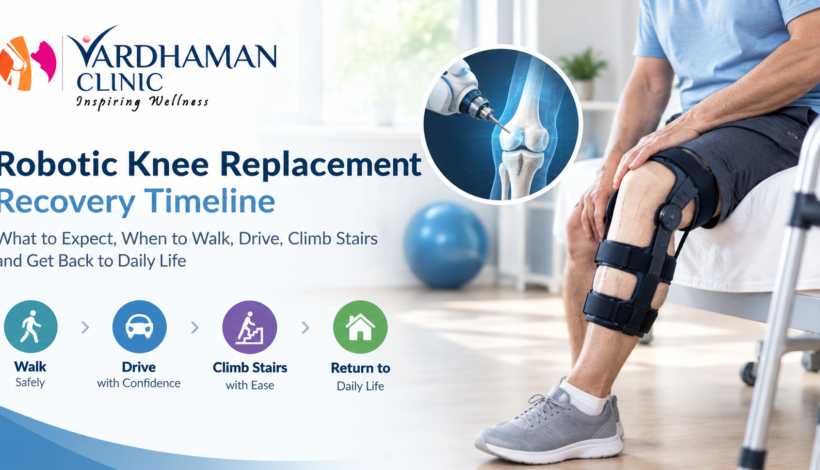

Robotic knee replacement recovery timeline showing walking, driving, stair climbing, and returning to daily activities

Robotic Knee Replacement Recovery: When Can You Walk, Drive and Climb Stairs?

Robotic knee replacement uses computer-guided technology to help surgeons plan and position the knee implant with more precision than freehand instrumentation typically allows. But for most patients, the technology matters less than the everyday questions sitting underneath it. When can I walk without holding onto something? When can I drive again? Will stairs ever stop feeling risky?

Robotic assistance can improve implant alignment and, in some cases, make the surgical experience smoother, but it does not come with a fixed recovery clock. Robotic knee replacement recovery still depends on the person: age, fitness level, other health conditions, and how consistently the rehabilitation plan gets followed. Surgeons offering robotic total knee replacement and minimally invasive knee replacement, such as Dr. Abhay Chhallani, an orthopedic surgeon in Nerul, Navi Mumbai, generally guide patients through a similar broad recovery arc, even though the exact pace differs from person to person. What follows is a general picture of how recovery tends to unfold.

How Long Does Robotic Knee Replacement Recovery Take?

For most patients, walking independently, managing daily tasks, and getting back to most normal activities takes roughly three to six months. Full strength and stamina can keep improving for up to a year in some cases.

Robotic assistance helps with surgical precision, but it does not speed up biology. Bone, soft tissue, and muscle still need time to heal no matter how accurately the implant was positioned. Two patients who have the same robotic total knee replacement, with the same surgeon, can still end up on noticeably different timelines depending on where they started.

Several factors shape robotic knee replacement recovery time, including:

  • Age and general health before surgery
  • Muscle strength and mobility going into the procedure
  • Body weight
  • Presence of other conditions such as diabetes or cardiovascular disease
  • How early and consistently physical therapy begins
  • Pain tolerance and pain management
  • Individual healing response, which varies from person to person

Robotic Knee Replacement Recovery Timeline

Every patient heals at a different pace, but recovery generally follows a broad pattern.

First few days Most patients stand and take a few assisted steps within 24 hours of surgery, often with a walker. Pain and swelling tend to be at their worst here and are managed with prescribed medication, ice, and elevation. Hospital stays are usually short, sometimes one or two nights, occasionally same-day, especially with minimally invasive total knee replacement techniques.

Week 1 to 2 Walking distances around the house increase gradually. Swelling and stiffness are still there but should start easing with consistent icing, elevation, and prescribed exercises. Physical therapy usually starts in this window, mostly gentle range-of-motion work.

Weeks 3 to 6 Many patients move from a walker to a cane, and some drop the walking aid altogether depending on strength and balance. Short outdoor walks get more manageable. Light tasks like cooking or a quick errand may resume, though standing for long periods can still bring on fatigue or swelling.

Weeks 6 to 12 Strength and range of motion keep building. Longer walks and lighter household chores start to feel doable. This is usually when therapy shifts toward more targeted strengthening work.

3 to 6 months and beyond Most patients notice real improvement in walking, stairs, and general mobility by this point. Some return to low-impact activities like swimming or cycling once the surgeon approves. Full strength and stamina can keep improving for up to a year.

When Can You Walk After Robotic Knee Replacement?

Walking usually starts the same day or the day after surgery, with a physiotherapist or nurse close by. A walker is common in the early days and weeks, giving the knee something to lean on while it adjusts to bearing weight again.

As strength and confidence build, most patients move from a walker to a cane and eventually walk unassisted, though the exact timing varies quite a bit. Knee replacement walking recovery tends to be gradual rather than sudden: a handful of supervised steps in week one, short walks around the house by week two, and longer walks outdoors somewhere around weeks four to six for many patients.

Things that affect how quickly walking improves include:

  • Muscle strength before surgery
  • How closely rehabilitation exercises are followed
  • Pain and swelling levels
  • Balance and coordination
  • Any other joint or mobility issues

Walking aids should be used exactly as instructed, and it’s worth resisting the urge to move faster than the body and physiotherapist recommend.

When Can You Drive After Knee Replacement?

There’s no single date that works for everyone here. Driving needs quick reaction times, comfortable pedal control, and enough movement in the operated leg to react without hesitation, and all of that takes time to come back.

A few things generally need to be in place before driving makes sense:

  • Adequate strength and control in the operated leg
  • Enough knee bend to sit comfortably and work the pedals
  • Little to no reliance on strong pain medication, since it can dull alertness
  • Confidence in being able to perform an emergency stop

Because these factors are different for every patient, it’s best to wait for clearance from the orthopedic surgeon before driving again. Getting behind the wheel too early, even if the knee “feels fine,” can put the patient and everyone else on the road at risk.

When Can You Climb Stairs After Knee Replacement?

Stairs often show up early in physical therapy, sometimes within the first week, though usually under supervision at first.

A safer approach in the early weeks looks like this:

  • Lead with the non-operated leg going up
  • Lead with the operated leg going down
  • Keep a hand on the rail
  • Use a cane or walker on stairs if the physiotherapist recommends it

As strength, balance, and confidence build over the following weeks, stairs stop feeling like such a project. It’s worth avoiding stairs without a handrail or support until the physiotherapist gives the go-ahead.

Physical Therapy After Robotic Knee Replacement

Physical therapy does a lot of the heavy lifting in recovery. Surgery fixes the joint, but therapy is what retrains the muscles, tendons, and nerves around it to work together again.

A typical rehabilitation program focuses on:

  • Restoring range of motion in the knee
  • Rebuilding strength in the thigh and surrounding muscles
  • Improving balance and coordination
  • Supporting a normal, steady walking pattern
  • Gradually restoring functional mobility for daily tasks

Skipping sessions or rushing through them can slow things down and leave the knee stiffer or weaker later on. Patients who stay consistent with both their sessions and home exercises tend to end up with better long-term outcomes.

Robotic Knee Replacement Rehabilitation Exercises

Exercises are usually introduced in stages, starting gentle and building up as healing allows. Ones commonly prescribed include:

  • Ankle pumps: support circulation, especially in the early days
  • Quadriceps sets: activate thigh muscles without much knee movement
  • Heel slides: gently work on knee bending
  • Straight-leg raises: build thigh strength while protecting the joint
  • Knee-bending and straightening exercises: restore range of motion
  • Walking exercises: rebuild a steady gait
  • Progressive strengthening exercises: added later to build lasting muscle support

These should only be done as instructed by the treating surgeon or physiotherapist. The right exercises, reps, and progression depend on individual healing and what the surgery found.

What Factors Affect Knee Replacement Recovery Time?

Recovery speed comes down to a mix of things, including:

  • Age: younger patients sometimes hit certain milestones faster, though not always
  • Overall fitness: better baseline conditioning tends to support smoother rehab
  • Muscle strength: stronger surrounding muscles help stabilize the new joint
  • Pre-surgery mobility: patients who moved well before surgery often adapt more easily afterward
  • Weight: extra weight adds stress to the healing joint
  • Other health conditions: things like diabetes or heart disease can slow healing
  • Pain and swelling levels: more of either can slow the pace of rehab
  • Physical therapy adherence: sticking with it consistently makes a real difference
  • Individual healing: every body responds to surgery a bit differently

Tips for a Safe Recovery After Robotic Knee Replacement

  • Stick closely to the rehabilitation plan from the surgical and physiotherapy team
  • Increase activity gradually instead of pushing too hard too soon
  • Do the prescribed exercises consistently, even on low-motivation days
  • Use walking aids correctly and only cut back on them when advised
  • Manage swelling with rest, elevation, and ice as recommended
  • Show up to follow-up appointments, even when recovery feels on track
  • Hold off on driving, strenuous activity, or high-impact movement until cleared

When Should You Contact Your Orthopedic Surgeon?

Some discomfort and swelling are normal after surgery, but a few symptoms call for prompt attention. Contact the orthopedic surgeon if any of these show up:

  • Pain that’s getting worse instead of better
  • Increasing redness, warmth, or swelling around the knee
  • Fever
  • Drainage or discharge from the surgical wound
  • Significant calf pain or swelling
  • Sudden shortness of breath or chest pain

These can sometimes point to infection or a blood clot and shouldn’t be brushed off.

FAQs

1. How long does robotic knee replacement recovery take? Most patients see significant improvement within three to six months, though full strength and stamina can keep improving for up to a year.

2. When can you walk normally after robotic knee replacement? Many patients are walking without an aid somewhere between six and twelve weeks, though it depends on individual healing and rehab progress.

3. When can you drive after robotic knee replacement? Usually once the surgeon clears it, which generally means pain medication has stopped and the operated leg has enough strength and control. Timing varies by patient.

4. When can you climb stairs after knee replacement? Often introduced within the first week using proper technique and support, getting easier as strength builds over the following weeks.

5. How long is physical therapy needed after knee replacement? Structured therapy commonly runs several weeks to a few months, with home exercises sometimes continuing longer as advised.

6. What exercises are recommended after robotic knee replacement? Ankle pumps, quadriceps sets, heel slides, straight-leg raises, and progressive strengthening exercises are common, all guided by a physiotherapist.

7. Is recovery faster after robotic knee replacement? Robotic assistance can support more precise implant positioning, but it doesn’t guarantee faster healing. That still comes down to the individual patient.

8. When can patients return to normal daily activities? Light daily activities often resume within a few weeks, while more demanding tasks typically come back gradually over three to six months.

Conclusion

Recovery from robotic knee replacement depends on more than the surgery itself. It comes down to overall health, how consistently physical therapy gets followed, and how closely the personalized recovery plan is stuck to. General timelines are useful as a rough guide, but every patient heals at their own pace. Patients in Nerul, Panvel, and Navi Mumbai considering robotic total knee replacement or minimally invasive knee replacement can discuss a personalized recovery plan with an experienced orthopedic surgeon like Dr. Abhay Chhallani. Staying in close touch with the surgeon and physiotherapist, and following their specific guidance on walking, driving, stairs, and daily activities, remains the safest way through recovery.

Knee pain and stiffness during the monsoon season

Why Does Knee Pain Increase During the Monsoon? Causes, Prevention & Treatment

The moment monsoon hits, knee pain seems to get louder. Maybe it’s a walk in the rain, the damp air, or just sitting inside more than usual. Whatever the reason, knees start feeling stiffer, and if you already deal with Knee arthritis or an old injury, you’ll probably feel it first.

Rain doesn’t actually cause knee pain on its own. Weather doesn’t create arthritis, and it doesn’t damage a joint by itself either. What it does is shift temperature, humidity, and how much you move around, and those shifts change how existing pain feels.

What’s Really Behind the Pain

Humidity climbs fast once the monsoon arrives. People with joint conditions often say they feel stiffer right around when the weather turns, and air pressure changes might play a role too, affecting the tissue around a joint that’s already sensitive. Nobody has fully mapped out why weather and pain track together, but ask around and most people with arthritis will tell you they notice a difference.

Then there’s the activity problem.

Rain makes it harder to walk or exercise outside. People naturally end up sitting more, and a knee joint that isn’t moving gets stiff. Regular activity is part of what keeps the muscles around it strong and the joint mobile, so cut that movement suddenly and the stiffness catches up fast. It turns into a loop: less movement, more stiffness, moving feels worse, so you move even less. The only real way out is staying active somehow, even indoors.

For people who already have knee arthritis, monsoon tends to bring more aching. Osteoarthritis happens when cartilage in the joint wears down over time, showing up as pain during movement, stiffness after sitting a while, swelling, trouble on stairs. Monsoon doesn’t cause any of that. It just turns up the volume on symptoms that were already there.

Cold plays a part too. Heavy rain usually brings cooler temperatures, and cold tends to make joints feel tighter for a lot of people. If your knee already bothers you, that tightness can turn something as ordinary as getting out of a chair or climbing stairs into a bit of a struggle.

Symptoms People Usually Notice

What shows up depends on the underlying cause. Some people get stiffness after sitting or resting. Others notice a dull ache around the knee, pain going up or down stairs, discomfort after walking for a while, mild swelling, or just a heavy, tight feeling around the joint that wasn’t there before the rains started.

A swollen knee isn’t automatically a weather thing, though. Swelling can come from arthritis, an injury, inflammation, infection, or other joint problems, so it’s worth figuring out which one it actually is rather than assuming.

Who Tends to Notice It Most

Osteoarthritis, a previous knee injury, meniscus problems, ligament injuries, inflammatory arthritis, chronic knee pain, weak muscles around the knee, a history of knee surgery. If any of these apply to you, you’ll probably feel weather changes before most people do.

That said, you don’t need a pre-existing condition for this to happen. Knee discomfort during monsoon can still show up if your activity level suddenly changes or you pick up an injury out of nowhere.

Preventing It Doesn’t Take Much

Don’t stay in one position too long. Gentle walking or stretching cuts down on stiffness, and if it’s raining too hard to go outside, indoor walking or basic mobility work does the job just as well.

Building some strength around the knee matters too. Stronger thighs and hips carry some of the load that would otherwise fall on the knee itself. What exercises make sense depends on your fitness level and any joint issues you already have, so if pain keeps coming back, it’s worth checking with a physiotherapist before starting anything new.

A few other things help along the way:

  • Warm up before exercise instead of diving straight in, since stiff joints handle sudden activity poorly
  • Keep your weight in check, because extra load on the knees adds up with every step and every stair
  • Wear footwear with good grip, especially on wet stairs and uneven pavement where falls are more likely
  • Stay warm if cold, damp weather tends to make your knee feel worse

What Actually Helps Treat It

It depends on the cause and how bad it is. For mild, occasional discomfort, doctors usually start with the basics: adjusting activity, targeted exercises, managing weight.

Pain that doesn’t go away often needs more. Physiotherapy, strengthening and flexibility work, pain relief medication when needed, managing an underlying arthritis condition, injections in some cases. Surgery usually only comes up for more advanced or structurally damaged knees. Either way, treatment should follow an actual evaluation, not a guess that the weather is behind it.

When It’s Time to See a Doctor

A little stiffness during the rains usually isn’t a big deal. But pain that keeps coming back, or getting worse, shouldn’t just get chalked up to “it’s the monsoon.”

Get it checked if it:

  • Continues for several weeks
  • Gets in the way of daily activities
  • Comes with noticeable swelling
  • Involves the knee locking up or giving way
  • Started after an injury
  • Comes with redness, warmth, or fever

If the pain is sudden and severe, there’s major swelling, or you can’t put weight on the leg at all, that needs medical attention right away, not a wait-and-see approach.

The Bottom Line

Rain doesn’t cause monsoon knee pain by itself. It’s everything that comes with the season, humidity, temperature drops, less movement, and whatever joint issues you already had, that changes how the pain feels.

Staying active safely, watching your weight, strengthening the muscles around the knee, and being careful on wet surfaces genuinely help if arthritis or chronic knee pain is already part of your life. Pain that sticks around is worth getting checked, not blamed on the weather.

Early signs of knee arthritis causing pain, stiffness, and swelling in the knee joint

Early Signs of Knee Arthritis You Should Never Ignore

Most of us blame knee pain on getting older, or on overdoing it at the gym last week. Honestly, that’s usually the real reason. But when the pain, stiffness, or swelling refuses to go away, when it keeps circling back week after week, it might actually be one of the early signs of knee arthritis rather than just something you can walk off. Sometimes it starts as early knee arthritis symptoms so mild you barely register them as anything worth mentioning to a doctor.

Here’s the thing though: catching it early won’t undo the condition. What it can do is give you a real head start. Recognizing the warning signs of knee arthritis in time and getting proper medical attention can slow it down, take the edge off the pain, and let you hold onto the life you’re used to for a lot longer than if you just kept ignoring it. That’s the whole point of paying attention to these early signals, protecting your knee joint health before you’re forced into damage control.

What Is Knee Arthritis, Exactly?

Strip it down and knee arthritis is just changes happening inside the joint, changes that cause pain, stiffness, swelling, and trouble moving. Osteoarthritis of the knee is the version most people run into, and it builds up slowly, over years usually, as the cartilage cushioning the joint wears thinner and thinner.

There’s more than one kind of arthritis in the knee, though, not just osteoarthritis. So it’s worth actually working out what’s causing your knee joint pain instead of jumping straight to osteoarthritis every single time.

1. Knee Pain That Keeps Coming Back

Probably the most recognizable of the early symptoms of knee arthritis: pain that shows up tied to something specific, a long walk, a workout, a set of squats, a few flights of stairs, and then fades. Then comes back. Then fades again. Left alone long enough, this on-and-off pattern is often how chronic knee pain actually gets started.

Some people feel it as a deep ache buried somewhere inside the joint. Others feel it more toward the front or the sides. Doesn’t really matter which, if the same pain keeps returning after the same kinds of things, that’s a pattern, not bad luck.

One sore knee after a rough leg day isn’t a big deal. It’s when the soreness turns into a routine, or starts showing up in things you never used to think twice about, that it’s worth actually paying attention.

2. Stiffness After Sitting or Waking Up

You know the feeling. You stand up after sitting a while and your knee needs a second before it’ll cooperate. That’s another possible sign of knee arthritis. This kind of knee stiffness shows up in a lot of ordinary moments, first thing in the morning, after too long at your desk, on a long drive, after sitting through a movie you probably should’ve paused halfway through.

Early on, moving around usually loosens it up fine. But if the stiffness keeps returning, especially with pain or trouble moving the joint the whole way, that’s worth mentioning to a doctor rather than pushing through it every time it happens.

3. Pain While Climbing or Descending Stairs

Stairs have a way of exposing knee trouble that flat ground quietly hides. Knee pain while climbing stairs starts feeling like way more effort than it should, and going down tends to be worse, since it puts even more strain through the joint on the way.

If stairs are getting harder to deal with, especially with some swelling or stiffness thrown in, that’s one of the more telling warning signs of knee arthritis you’ll come across.

4. Swelling Around the Knee

Swelling that keeps coming back isn’t something to just shrug off. Irritation inside the joint can leave the knee puffy or feeling tight, and a swollen knee joint often flares up after activity for a lot of people and settles down again with rest.

Get knee swelling checked if it’s persistent, or if it keeps showing up alongside pain and stiffness. It can come from more than one cause. Guessing isn’t really worth the risk.

5. Difficulty Fully Bending or Straightening the Knee

Losing range of motion happens slowly. That’s exactly why it’s an early sign of knee arthritis that so many people miss. Usually it shows up as small things getting a bit harder: squatting down, sitting on the floor, getting up from a low chair, bending the knee all the way, straightening the leg fully, climbing in and out of a car.

None of it announces itself. Compare how your knee moves today to how it felt a few months back, though, and the difference is often pretty obvious once you actually stop and check.

6. Grinding, Crackling, or Popping Sensations

Clicking or popping when you bend or straighten the knee is common enough, and most of the time it means nothing at all. Knees just do that sometimes, for no real reason.

It’s worth watching when that sound shows up together with pain, stiffness, swelling, or trouble moving. The noise itself usually isn’t the issue. What’s happening around it is.

7. Knee Pain After Long Periods of Activity

Early knee osteoarthritis symptoms tend to show up after activity that puts sustained load on the joint over time. Someone handles a twenty-minute walk fine, no problem, but starts feeling it on anything longer. Knee pain while walking longer distances, standing a full shift at work, a long day of traveling or shopping, all common early triggers people mention.

Instead of fixating on how bad the pain feels right in the moment, it’s usually more useful to just notice whether the amount of activity you can handle before it kicks in is quietly shrinking over time.

8. Weakness or a Feeling That the Knee May Give Way

Some people feel their knee go weak or unstable, and without even realizing it, start being more careful on uneven ground, when turning quickly, on stairs, getting up out of a chair. Small shift in behavior. But it changes how you move through your day without you really clocking it happening.

Instability can come from plenty of things besides arthritis. Still, take it seriously when it shows up alongside other knee symptoms that won’t quit. A doctor can help sort out whether it’s arthritis, weak muscles, an old injury, a ligament issue, or something else altogether.

Your Daily Routine Can Reveal Knee Arthritis

Honestly? One of the simplest ways to catch a developing knee problem is to just look at your own habits and ask what’s actually changed lately.

Maybe the walk to the market feels harder than it used to. Maybe stairs you never gave a second thought to now take real effort. Maybe you’ve quietly started skipping squats, cutting workouts short, taking more breaks than usual without really admitting it to yourself. None of that seems like much on its own. A few of these showing up together, though, usually means the knee isn’t handling things the way it used to.

Is Every Knee Pain a Sign of Arthritis?

No, not even close. Knee pain doesn’t automatically mean arthritis. There are plenty of other knee pain causes out there, injuries, tendon problems, ligament issues, a torn meniscus, bursitis, weak muscles, and other joint conditions can all cause symptoms that look a lot alike on the surface.

Googling your symptoms only gets you so far because of this. Where the pain sits, how long it’s stuck around, how bad it is, what triggers it, past injuries, your age, how active you are, all of that feeds into what’s actually going on.

What Increases the Risk of Knee Osteoarthritis?

Age plays a part, sure, but it’s nowhere near the whole story. Old knee injuries, extra body weight, repetitive stress on the joint, genetics, weak muscles, certain health conditions, all of it can push the risk up in different ways.

A history of knee injury deserves its own callout here, since damage from years back can still shape how the joint holds up much later in life. Knowing what raises your own risk makes it easier to stay ahead of your knee joint health instead of only reacting once it already hurts.

How Is Knee Arthritis Diagnosed?

No single symptom seals the diagnosis by itself. A doctor usually works from your symptoms, your history, and a hands-on exam, checking pain and tenderness, swelling, range of motion, joint stability, muscle strength, and how the knee handles movement.

Depending on what turns up, an X-ray or other tests might follow, especially if they want to rule out a different type of arthritis or something else entirely. A real knee arthritis diagnosis comes from putting the whole picture together, not any one symptom by itself.

Knee Arthritis Treatment: Can It Be Managed Without Surgery?

Not automatically, and honestly, that’s the good news here. What helps depends on how severe things are, what’s causing it, your overall health, how active you are day to day. Knee arthritis treatment without surgery usually includes the right kind of physical activity, strengthening work, physiotherapy, adjusting how you move, managing weight where that applies.

A healthcare professional can help work out which of those actually fit your situation. The goal, broadly, is simple: ease the discomfort, keep the knee moving, build up the muscles supporting it, let you keep doing what you normally do without thinking twice about it.

Why Ignoring Early Symptoms Can Be a Problem

When the knee starts hurting, the natural move is to just do less. Skip the workout. Avoid the stairs. Walk a shorter route. Sit more. Makes sense in the moment, honestly. But that drop in activity weakens the muscles around the joint, which makes movement even harder, and the whole thing starts feeding itself, sometimes turning into the kind of chronic knee pain that’s a lot harder to shake off once it settles in.

Noticing the early signs isn’t about assuming the worst. It just means paying attention when something shifts, and actually getting it checked instead of hoping it quietly disappears on its own.

When Should You See an Orthopedic Specialist?

Get the knee looked at if symptoms are sticking around, getting worse, or making everyday life harder. A few situations worth flagging:

  • Knee pain that keeps coming back
  • Swelling that shows up repeatedly
  • Stiffness affecting how you move day to day
  • Walking becoming genuinely difficult
  • Stairs getting more and more painful
  • A knee that feels weak or unstable
  • Range of motion that’s noticeably shrinking
  • Pain affecting sleep or your daily routine
  • Symptoms that haven’t budged despite rest and basic changes

Sooner is better here. It just makes it easier to pin down what’s actually going on before things get more complicated.

Common Myths About Knee Arthritis

People carry around a lot of assumptions about this condition, and some of them are worth clearing up.

Take the idea that knee arthritis only happens to older people, for one. Age raises the odds, sure, but past injuries, genetics, body weight, and repetitive joint stress can bring it on at pretty much any age, younger people included.

Then there’s the assumption that every clicking knee means arthritis. It doesn’t. Knees click and pop for all sorts of reasons, and the sound on its own proves nothing.

A lot of people also think exercise should be avoided entirely once arthritis is in the picture. Actually the opposite tends to be true, the right kind of exercise and strengthening work can genuinely help manage symptoms. It’s about matching the type and intensity to the person, not cutting movement out altogether.

And surgery isn’t automatic either, despite what a lot of people assume. It depends entirely on severity and the person’s own situation. Plenty of people manage well with non-surgical treatment, at least for a good while.

Frequently Asked Questions

What are the first signs of knee arthritis? Recurring pain, stiffness after resting, swelling, trouble on stairs, less range of motion, discomfort after being active for a while.

What does early knee arthritis feel like? Usually an ache, some stiffness, tenderness, or general discomfort while moving, often only after specific activities at first.

Can knee arthritis start suddenly? It usually builds up slowly, even if it feels sudden the day you finally notice it. Pain and swelling that hit hard and fast are more likely something else, and worth getting checked promptly.

Is knee stiffness an early sign of arthritis? Yes, recurring knee stiffness can be one of the early symptoms of knee arthritis, especially alongside pain or reduced movement.

Does walking cause knee arthritis? No. Movement is generally good for joint health. If you already have knee problems though, knee pain while walking longer distances is a sign you might need to dial back how much or how hard you’re going.

Can early knee arthritis be treated without surgery? Often, yes. Depending on the cause and severity, knee arthritis treatment can start with exercise, strengthening, physiotherapy, and activity changes, guided by a healthcare professional.

Final Thoughts

The earliest signs of knee arthritis are small enough to brush right past. A little stiffness after sitting. Some discomfort on the stairs. Swelling that keeps coming back. Pain after a walk that used to feel effortless. None of it seems like much when you look at any one of them alone.

But once these start happening regularly, or start getting in the way of things you never used to think twice about, they’re worth paying attention to. Instead of chalking up ongoing knee pain to just getting older, figure out what’s actually behind it while the problem is still manageable. Recognizing the early signs of knee arthritis and the warning signs of knee arthritis in time, moving the right way, building strength, getting checked when something changes, that combination goes a long way toward protecting your knee joint health and keeping you living the active life you’re used to.

Knee replacement cost in Navi Mumbai showing knee pain, knee implant, robotic and traditional knee replacement surgery, insurance coverage, and treatment options.

Knee Replacement Cost in Navi Mumbai: What Determines the Price

If you have been living with knee pain for months or years, you have probably already searched for the knee replacement cost in Navi Mumbai more than once. It is one of the first questions every patient asks, and it should be. Knee replacement is a major decision, both medically and financially, and you deserve a clear answer instead of a vague “it depends.”

The honest truth is that the total knee replacement price in Nerul, Panvel, and the rest of Navi Mumbai varies quite a bit from hospital to hospital and surgeon to surgeon. On average, patients in this region can expect to pay somewhere between ₹1,75,000 and ₹4,50,000 per knee, though complex cases or premium implants can push this higher. This blog breaks down exactly what goes into that number, compares robotic vs traditional knee replacement cost, explains what a typical hospital package includes, and covers PMJAY knee replacement coverage and insurance options, so you can plan your surgery with confidence rather than guesswork.

Understanding Knee Replacement Cost in Navi Mumbai

Knee replacement, also called knee arthroplasty, involves replacing a damaged or arthritic knee joint with an artificial implant made of medical-grade metal and plastic. It is one of the most successful orthopedic procedures performed today, with a high long-term success rate. But because it involves surgical expertise, imported implants, hospital infrastructure, and post-operative care, the final bill depends on several moving parts.

Broadly, here is what patients across Nerul, Panvel, Kharghar, Vashi, and CBD Belapur can expect:

  • Basic package (traditional technique, standard implant): ₹1,75,000 to ₹2,50,000
  • Mid-range package (better implant brand, semi-private room): ₹2,50,000 to ₹3,50,000
  • Robotic or navigation-assisted surgery with premium implants: ₹3,50,000 to ₹6,00,000+

These figures are per knee. If both knees need replacement in the same sitting (bilateral knee replacement), the cost naturally increases, though many hospitals offer a discounted combined package.

Key Factors That Determine Knee Replacement Surgery Price

Understanding why prices differ so much helps you compare quotes intelligently rather than simply picking the cheapest option. Here are the main factors that affect knee replacement surgery price in Navi Mumbai.

1. Type of Implant Used

The knee implant cost in India is one of the biggest variables. Implants range from standard domestic brands to premium imported ones from companies like Johnson & Johnson, Zimmer Biomet, Stryker, and Smith & Nephew. Imported implants generally last longer, offer better range of motion, and come with stronger warranties, but they also cost more. A single implant set can range from ₹40,000 for a basic domestic option to over ₹1,50,000 for a high-end imported one.

2. Robotic vs Traditional Technique

This is where many patients get confused, so let’s compare robotic vs traditional knee replacement cost directly.

Traditional knee replacement relies on the surgeon’s manual skill and instrumentation to cut and align the bone. It has been performed successfully for decades and remains a reliable, cost-effective option.

Robotic knee replacement uses computer-assisted, image-guided technology to plan the surgery down to the millimeter before the first incision is made. This improves implant alignment accuracy, can reduce soft tissue damage, and often leads to a smoother recovery. The trade-off is cost. The robotic knee replacement cost in India typically runs ₹80,000 to ₹1,50,000 higher than the traditional approach because of the technology and equipment involved.

Neither option is universally “better” for every patient. Your surgeon should assess your knee anatomy, bone quality, and lifestyle before recommending one over the other, rather than pushing the more expensive option by default.

3. Hospital Category and Room Type

A best orthopedic hospital in Nerul or Panvel with NABH accreditation, modern operation theatres, and a dedicated joint replacement unit will naturally charge more than a smaller nursing home. Room category also matters a lot. General ward, semi-private, private, and deluxe rooms each carry a different daily rate, and since a knee replacement typically involves a 3 to 5 day hospital stay, this adds up.

4. Surgeon’s Experience and Fees

An experienced orthopedic surgeon in Navi Mumbai. who has performed hundreds of successful knee replacements will usually charge a professional fee that reflects that expertise. This is not a place to cut corners. A skilled surgeon reduces the risk of complications, revision surgery, and long recovery times, which ultimately saves money and pain in the long run.

5. Pre-Surgery Tests and Anesthesia

Before surgery, doctors run blood tests, ECG, X-rays, and sometimes an MRI to assess joint damage and confirm you are fit for anesthesia. These diagnostics usually cost between ₹5,000 and ₹15,000 depending on how many tests are needed. Anesthesia and OT charges are typically bundled into the surgical package but are worth asking about specifically.

6. Post-Surgery Physiotherapy and Follow-Up

Recovery does not end when you leave the hospital. The knee replacement recovery cost includes physiotherapy sessions, follow-up consultations, medications, and sometimes home care support. Some hospitals include a set number of physiotherapy sessions in the package, while others charge separately. Always clarify this upfront.

7. City and Locality

Location within Navi Mumbai also plays a role. Knee replacement cost in Panvel can differ slightly from rates in Nerul or Vashi simply because of variations in real estate and operating costs between hospitals in these areas. It is worth comparing two or three centers in your preferred locality before finalizing.

What Is Typically Included in a Knee Replacement Package Cost

One of the most common complaints patients have after surgery is unexpected charges. A transparent knee replacement package cost should ideally include:

  • Surgeon and anesthetist fees
  • Operation theatre and equipment charges
  • The knee implant itself
  • Hospital room stay for the standard duration (usually 3 to 5 days)
  • Nursing care during admission
  • Standard medications during the hospital stay
  • Routine post-operative dressing and check-ups

What is often excluded and billed separately:

  • Pre-admission diagnostic tests
  • Blood transfusion, if required
  • ICU stay beyond the standard package (only needed in rare cases)
  • Extended physiotherapy after discharge
  • Any additional imaging if complications arise

Before you commit to a hospital, ask for a written, itemized estimate. A good clinic will never hesitate to give you this in writing, and if a surgeon’s team is reluctant to break down the numbers, treat that as a red flag.

Knee Replacement Insurance Coverage and Government Schemes

Cost should never be the reason someone continues to suffer from debilitating knee pain, and thankfully there are several ways to manage the financial side.

Health Insurance

Most standard health insurance policies in India, including those from private insurers and corporate group policies, cover knee replacement insurance coverage as part of inpatient hospitalization benefits, provided the policy has completed its waiting period for pre-existing conditions (usually 2 to 4 years for osteoarthritis-related claims). Cashless treatment is available at most network hospitals in Navi Mumbai, which means you may not need to pay upfront at all. It is worth calling your insurer directly to confirm your specific coverage limit and any sub-limits on implants, since some policies cap the amount they will pay for the implant itself.

PMJAY Knee Replacement Coverage

For families covered under Ayushman Bharat, PMJAY knee replacement coverage offers cashless treatment up to ₹5 lakh per family per year at empaneled government and private hospitals. Knee replacement is included in the list of over 1,900 procedures covered under the scheme, and the package is designed to cover the surgery, implant, hospitalization, medicines, and a period of follow-up care with no out-of-pocket cost at empaneled centers. If you or a family member holds an Ayushman card, it is worth checking which hospitals in Nerul, Panvel, or Navi Mumbai are empaneled under PMJAY before choosing where to get treated.

EMI and No-Cost Financing

Many hospitals and clinics now partner with financing companies to offer EMI options, allowing patients to spread the knee replacement surgery price over several months without a heavy upfront burden. If insurance coverage is limited, this can be a practical middle path.

Affordable Knee Replacement in Navi Mumbai: How to Choose Wisely

Searching for affordable knee replacement in Navi Mumbai does not mean choosing the lowest quote blindly. Here is a simple checklist to compare options the smart way:

  1. Ask for a complete written estimate, not a verbal range.
  2. Check the surgeon’s experience with your specific implant type and technique, robotic or traditional.
  3. Confirm what is included in the package versus what will be billed extra.
  4. Ask about the implant brand and its warranty period.
  5. Understand the expected hospital stay and whether physiotherapy is bundled in.
  6. Check hospital accreditation and infection control track record.
  7. Ask about revision surgery rates, since a lower price sometimes reflects lower-quality implants that wear out sooner.

A slightly higher upfront cost with a trusted surgeon and a genuine, high-quality implant is almost always a better long-term investment than the cheapest available option.

Knee Surgery Cost Comparison: Robotic vs Traditional at a Glance

FactorTraditional Knee ReplacementRobotic Knee Replacement
Average cost per knee₹1,75,000 to ₹2,75,000₹3,00,000 to ₹6,00,000
PrecisionSurgeon-dependent, manual alignmentComputer-guided, higher accuracy
Recovery time4 to 6 weeks for basic mobilityOften slightly faster due to less soft tissue disruption
Best suited forStraightforward cases, cost-conscious patientsComplex deformities, patients wanting maximum precision
Implant longevity15 to 20 years with good techniqueComparable, with potentially better alignment outcomes

This knee surgery cost comparison should be discussed directly with your surgeon, since the right choice depends on your knee’s condition, not just your budget.

Why Transparency Matters When Choosing Your Surgeon

The single biggest source of patient anxiety around knee replacement is not the surgery itself. It is the uncertainty around cost. Dr. Abhay Chhallani, a trusted orthopedic surgeon in Navi Mumbai based in Nerul, is known for offering clear, itemized cost estimates before surgery, using imported implants from established manufacturers like Johnson & Johnson and Zimmer, and walking patients through robotic and traditional options honestly, based on what is medically appropriate rather than what is more profitable. For patients in Nerul, Panvel, and the wider Navi Mumbai region who want a best knee replacement surgeon in Nerul with a reputation for straightforward communication, this kind of transparency makes a real difference during an already stressful decision.

If you are exploring your options, the best next step is a detailed consultation where your X-rays, medical history, and lifestyle needs are reviewed, followed by a written cost breakdown tailored to your case rather than a generic online estimate.

Frequently Asked Questions

What is the average knee replacement cost in Navi Mumbai?
Most patients pay between ₹1,75,000 and ₹4,50,000 per knee, depending on implant choice, technique, and hospital category.

Is robotic knee replacement worth the extra cost?
For patients with complex deformities or those who want the highest possible alignment precision, yes. For straightforward cases, traditional knee replacement remains a reliable and more affordable option with excellent outcomes.

Does insurance cover knee replacement surgery in Navi Mumbai?
Most comprehensive health insurance policies cover it after the waiting period for pre-existing conditions is completed. Always confirm implant sub-limits with your insurer beforehand.

Is knee replacement free under PMJAY?
Eligible Ayushman Bharat cardholders can get knee replacement surgery cashless at empaneled hospitals, with no out-of-pocket cost, up to the scheme’s annual family limit of ₹5 lakh.

How long does recovery take after knee replacement?
Most patients can walk with support within a day or two and return to routine activities within 4 to 6 weeks, with full recovery over 3 to 6 months.