
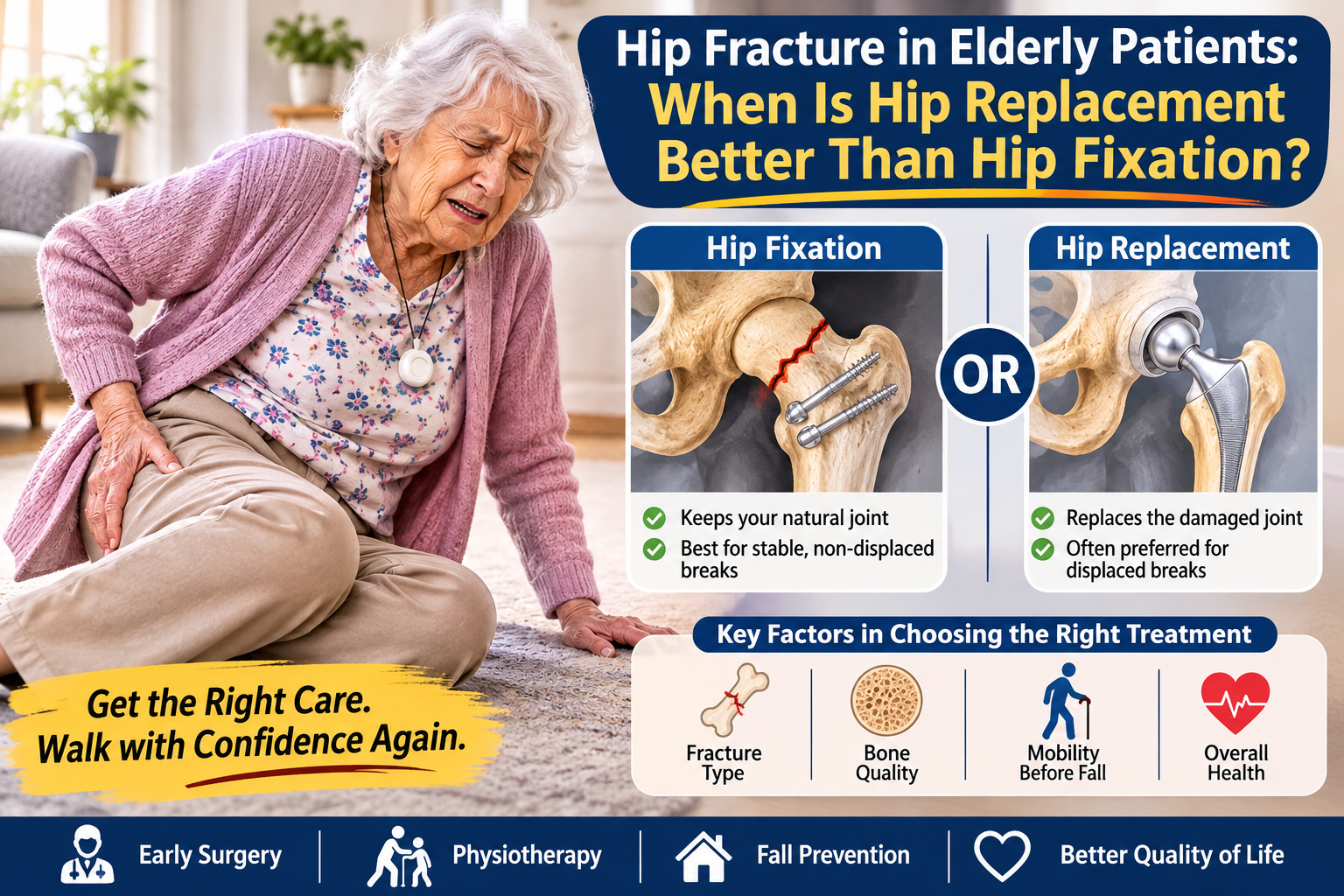
Picture a 79-year-old grandmother who has managed her own mornings for years. She steps out of the bathroom, her foot catches the edge of a mat, and she goes down. She cannot get up, and the pain in her groin is sharp enough to make her cry out. (This is an illustrative example, not a real patient.) Within hours, her family is in an emergency room, hearing words like fracture, surgery and replacement, and trying to make sense of all of it.
When it comes to hip fracture in elderly patients, one of the first questions families ask is whether the broken bone should be repaired with screws or a nail, or whether the damaged part of the joint should be replaced altogether. There is no single answer for everyone, but there are clear patterns that guide surgeons.
In many older adults, replacement is better than fixation when the thigh-bone neck is displaced, the bone is too fragile to hold screws, or the person was walking independently before the fall. Fixation suits stable, undisplaced breaks and younger or very frail patients. The final choice depends on fracture type, bone quality, mobility and overall health.
This guide walks through what the injury is, how it is diagnosed, what each operation involves and how to prepare for recovery. It is written in plain language so you can ask better questions when you sit down with your orthopaedic surgeon.
What Is a Hip Fracture?
A hip fracture is a break in the upper part of the thigh bone (the femur), close to where it meets the pelvis. The hip is a ball-and-socket joint: the rounded top of the femur is the ball, and a cup in the pelvis is the socket. When the break happens near the ball, the blood supply to that part of the bone can be affected, and that is a big reason treatment choices differ from person to person.
A hip joint fracture is usually described by where the break sits. Surgeons broadly talk about three zones: the femoral neck (just below the ball), the intertrochanteric region (a little further down, where two bony bumps sit), and the subtrochanteric region (just below those bumps). Each zone heals differently and often calls for a different operation.
The neck of the femur is also divided into two broad patterns. Breaks inside the joint capsule, called intracapsular, can cut off blood flow to the ball. Breaks outside the capsule, called extracapsular, generally keep a better blood supply, so the bone has a good chance of healing once it is held steady.
Why Are Elderly Patients More Vulnerable to Hip Fractures?
Osteoporosis and hip fractures go hand in hand. Osteoporosis makes bones thinner and more porous, often without any warning signs, so a fall that a younger person would shrug off can break an older person’s bone. Women lose bone more quickly after menopause, but men are affected too, especially with advancing age, low vitamin D, smoking, long-term steroid use and certain medical conditions.
Falls are the other half of the story. Poor eyesight, slow reflexes, weak leg muscles, dizziness from blood pressure medicines, poor lighting, loose rugs and slippery bathroom floors all raise the risk. Many older adults also fall at night on the way to the toilet, when they are half asleep and the room is dark.
This is why prevention matters as much as treatment. Regular vision checks, a review of medicines, strength and balance exercises, calcium and vitamin D as advised by a doctor, and a safer home can all lower the chances of another fall.
Hip Fracture Symptoms in Elderly Patients
Hip fracture symptoms in elderly patients can be obvious, but not always. The classic picture is sudden pain in the hip or groin after a fall, along with being unable to stand or put weight on the leg.
Other hip fracture symptoms include bruising or swelling around the hip, the injured leg looking shorter than the other, and the foot turning outwards. Even gentle movement of the leg may be very painful.
In some older adults, the signs are quieter. A person may complain only of knee or thigh pain, walk with a new limp, or suddenly refuse to get out of bed. A sudden bout of confusion after a fall can also be the first clue, especially in people with dementia who cannot describe their pain well. If a fall is followed by any of these, do not wait to see whether it settles.
Seek emergency help if your loved one cannot stand, cannot lift the leg, has severe pain or a visibly deformed leg. Try not to move them, keep them warm and comfortable, and avoid giving food or drink in case an operation is needed soon.
How Is a Hip Fracture Diagnosed?
The doctor will first ask how the fall happened, examine the leg and check blood pressure, pulse and any other injuries. An X-ray is usually the first test and is often enough to show the break and whether the bone pieces have moved apart.
Sometimes the X-ray looks normal even though the pain is severe, because tiny cracks can hide on a plain picture. In that case, an MRI or CT scan may be advised to look more closely.
Alongside scans, the team will usually arrange blood tests, a heart tracing (ECG) and a review of the person’s medicines to check whether they are fit for anaesthesia. You will also be asked how well your relative was walking before the fall, whether they lived alone, and whether memory problems were present. These everyday details strongly influence which operation is chosen.
Hip Fracture Treatment Options
Hip fracture treatment in older adults is almost always surgical. Staying in bed for weeks while a bone heals brings serious risks of its own, such as pressure sores, chest infections, blood clots and rapid muscle loss. A small number of people who are extremely frail or too unwell for anaesthesia may be managed without an operation, with the focus on comfort and pain control.
The aim of hip fracture surgery is simple: relieve pain and get the person out of bed and standing again as soon as it is safe. NICE guidance recommends operating on the day of admission or the day after, provided the person is medically ready.
Hip joint fracture treatment broadly falls into two surgical families. In one, the surgeon keeps the patient’s own bone and holds it in position with metal implants. In the other, the broken part of the joint is removed and replaced with an artificial one. Which family fits depends on fracture location, displacement, bone quality, mobility and overall health.
The American Academy of Orthopaedic Surgeons (AAOS) and the UK’s National Institute for Health and Care Excellence (NICE) both support early surgery followed by early walking with physiotherapy. Both also stress that the operation should be matched to the individual, not applied to everyone alike.
What Is Hip Fixation Surgery?
Internal fixation surgery keeps the natural joint and repairs the broken bone with hardware. Depending on the break, the surgeon may use screws, a sliding hip screw with a side plate, or a long metal rod called an intramedullary nail that runs down the inside of the femur.
The idea is to hold the pieces together in the right position until the bone knits. It is often a shorter operation with less blood loss than a replacement, which matters for very frail patients. The catch is that healing depends on the bone’s blood supply and strength. If the bone is too weak or the fragments have separated too much, the fixation can fail and a second operation may be needed.
What Is Hip Replacement Surgery?
So, what is a hip replacement? In simple terms, it is an operation in which the damaged ball, or both the ball and the socket, are removed and replaced with artificial parts made of metal, ceramic and strong medical-grade plastic. The new parts take over the job of the old joint, so the person can bear weight without relying on a broken bone to heal.
A hip replacement done after a break is slightly different from one planned for long-standing arthritis. The surgery is often more urgent, and the patient is usually more fragile. Surgeons therefore plan carefully around anaesthesia, bone quality and whether the implant should be fixed with bone cement.
Hip surgery of this kind is commonly done under spinal anaesthesia, sometimes with light sedation, which many older people tolerate well. Your anaesthetist will explain which approach is safest after reviewing your heart, lungs, kidneys and medicines.
The term hip joint replacement covers any operation that swaps part or all of the joint for an implant. Surgeons choose between a partial and a full version depending on how active the patient was and how healthy the socket is.
A hip joint replacement surgery after a fall often takes somewhere between one and two hours, though this varies with the patient and the surgeon’s technique. Most people are encouraged to stand with help within a day or so.
Types of Hip Replacement Surgery
There are several types of hip surgery used after a break. The two big categories are fixation (screws, plates or nails) and replacement (partial or full). Within replacement, the choice is between a partial and a complete implant.
Hemiarthroplasty, also called a partial replacement, replaces only the ball of the joint. The surgeon removes the broken femoral head and neck and fits a metal stem with a new ball on top, which sits in the patient’s own socket. It is a shorter operation than a full replacement and tends to carry a lower risk of dislocation, which is why it is often chosen for older, less active or more frail patients.
Total hip replacement replaces both the ball and the socket. The socket surface is reshaped and fitted with a cup, and the stem and ball go into the femur. It gives a fresh, smooth joint surface on both sides and is generally favoured for patients who were active and independent before the injury.
To define total hip replacement in one line: it is an operation that replaces both parts of the damaged joint with artificial components to relieve pain and restore movement. The stem can be fixed with bone cement or left uncemented, and in older patients with fragile bone, cemented stems are commonly preferred.
Hip Replacement vs Hip Fixation: What’s the Difference?
A quick look at hip replacement vs hip fixation shows that they are two different strategies for two different problems. Fixation repairs the broken bone, while replacement removes the damaged part of the joint and substitutes an implant. The table below sets out the main differences.
| Feature | Fixation | Replacement (partial or full) |
| What it does | Holds the broken bone together with screws, plates or a nail | Removes the damaged ball (and sometimes the socket) and fits an implant |
| Typical break | Non-displaced neck breaks and breaks outside the joint capsule | Displaced neck breaks inside the joint capsule |
| Operation time and blood loss | Usually shorter, less blood loss | Usually longer, a little more blood loss |
| Weight-bearing after surgery | Usually allowed as tolerated, as advised by the surgeon | Usually allowed early, as advised by the surgeon |
| Chance of a second operation | Higher when the neck break is displaced | Generally lower in displaced neck breaks |
| Dislocation risk | Not applicable | Small, higher with full replacement than partial |
| Best suited to | Stable breaks, very frail patients, some younger patients | Displaced neck breaks, fragile bone, independent older adults |
No column wins every row. A shorter operation is wonderful for a frail patient, but a higher chance of a second operation matters a lot to someone who was otherwise active. This is why surgeons weigh the whole person rather than the X-ray alone.
When Is Hip Replacement Better Than Hip Fixation?
A displaced femoral neck fracture is the situation where replacement most often comes out ahead. When the broken ends have slipped apart inside the joint capsule, the blood supply to the ball is usually badly damaged. Screws may hold the pieces in place, but the bone can fail to heal or can slowly lose its blood supply and collapse, leading to pain and another operation.
For femoral neck fracture treatment in older adults, both AAOS and NICE guidance support replacement rather than fixation for most people with a displaced break. NICE specifically suggests a full replacement for people who were walking independently outdoors with no more than a stick, do not have cognitive impairment, and are fit for the anaesthetic and surgery. Others are usually offered a partial replacement with a cemented stem.
Replacement may also be considered when the bone is very osteoporotic and unlikely to hold screws, when the joint already has significant arthritis, when an earlier fixation has failed, or when the break is a few weeks old and has not healed.
Think of it this way: if the blood supply to the ball has already been cut off, repairing it with screws is a bit like patching a branch that has been separated from the tree. Replacing it gives a stable, reliable solution that does not depend on the bone healing.
When Is Hip Fixation the Better Option?
A non-displaced hip fracture, one where the bone is cracked but the pieces are still lined up, often does well with fixation. Because the blood supply is more likely to be intact, the bone has a good chance of healing, and the patient keeps the natural joint.
Fixation is also the standard choice for extracapsular breaks, such as intertrochanteric fractures, where the break lies outside the joint capsule. A sliding hip screw or a nail is usually used, and replacing the joint is rarely necessary.
It may also be preferred in very frail patients who would struggle with a longer operation, and in younger or physically active people with good bone quality who have a displaced break, where saving the natural joint is a priority. These are judgement calls, and different surgeons may weigh them slightly differently, which is why a second opinion can be reasonable.
Benefits of Hip Replacement Surgery in Elderly Patients
The main hip replacement surgery benefits for older adults with a displaced break are less pain, a joint that can take weight soon after the operation, and a lower chance of needing another operation compared with fixation. It also removes the worry about whether a damaged bone will heal.
A well-fitted implant can help people return to their usual activities, such as walking to the shops or managing stairs, although results vary and nobody can promise a particular outcome. Many patients find that less pain gives them back confidence and independence.
There is a quieter benefit too. Getting out of bed early lowers the risks that come with lying still, including chest infections, blood clots and pressure sores. For families, fewer repeat visits to hospital can make the whole journey less stressful.
Risks and Complications of Hip Surgery
Hip surgery in elderly patients carries risks, and honest conversations about them help families make better decisions. Older adults are more likely to have heart, lung, kidney or diabetes problems, and any operation puts the body under stress.
Hip fracture surgery complications can include infection, bleeding, blood clots in the legs or lungs, pneumonia, urinary infections and pressure sores. Delirium, a sudden state of confusion, is also common after surgery and anaesthesia in older people, especially those with dementia. It often improves with time but can be very frightening for families.
Problems more specific to replacement include dislocation (the new ball slipping out of its socket), a difference in leg length, loosening of the implant over time, and a break in the bone around the implant. Dislocation is more likely after a full replacement than a partial one.
Problems more specific to fixation include the bone not healing, loss of blood supply to the ball, and screws cutting through weak bone. Any of these may lead to further surgery, often a replacement.
Your surgeon will estimate your personal risk by considering your age, other illnesses, medicines and fitness. Ask them to explain how each risk applies to you and what the team will do to lower it, such as blood-thinning treatment, early walking and a careful medicine review.
Recovery Period After Hip Surgery
The recovery period for hip surgery is a journey of weeks to months rather than days. Most patients are helped to sit and stand within a day or so, and physiotherapy usually begins on the first or second day. A hospital stay of several days is common, after which some people move to a rehabilitation unit while others continue therapy at home.
Hip fracture recovery in elderly patients is rarely a straight line. There will be good days and tired days, and pain, appetite, sleep and mood all affect progress. Many people regain much of their walking ability over several months, but some do not fully return to their earlier level, and a few need a walking aid or extra help at home. Setting realistic expectations early helps everyone.
Physiotherapy is the engine of recovery. Early sessions focus on getting out of bed, standing and taking steps with a frame or stick. Later sessions build leg strength, balance and confidence. Surgeons usually allow the patient to put weight on the leg soon after the operation, but your team will give specific instructions for your relative.
After a replacement, you may be given movement precautions for the first weeks, such as avoiding deep bending or crossing the legs, depending on the surgical approach. Follow them carefully, because they lower the chance of the new ball slipping out.
Nutrition and bone health matter too. Protein, calcium and vitamin D support healing, and a doctor may recommend treatment for weak bones to lower the risk of another break. Please do not start supplements or medicines without medical advice.
How Families Can Support Elderly Patients During Recovery
Families often feel helpless in the first few days, but your presence matters more than you think. Familiar voices calm a confused or anxious patient, and having someone to speak for them in the ward helps the care team understand their usual habits and abilities.
Prepare the home before discharge. Remove loose rugs and clutter, add night lights between bed and bathroom, fit grab rails, use a raised toilet seat and a firm chair with arms, and keep the walker within reach. A bed on the ground floor can save a lot of stress in the early weeks.
Help with the practical side of recovery. Keep a medicine chart, attend physiotherapy sessions if you can, and encourage the daily exercises. Watch for warning signs and call the doctor if you notice increasing pain, redness or discharge from the wound, fever, swelling or tenderness in the calf, breathlessness or a sudden change in confusion.
Be patient, and avoid doing everything for them. Letting your relative do what they safely can builds confidence, and small wins, like walking to the window unaided, deserve celebration. Caregivers need rest and support too, so share the load among family members where possible.
Questions to Ask Your Orthopaedic Surgeon
- Where exactly is the break, and has it moved out of position?
- Why do you recommend fixation or replacement in this case?
- If replacement, why a partial or a full one?
- How likely is another operation with each option?
- Which type of anaesthesia is safest given our health conditions?
- When can my relative stand and put weight on the leg?
- Are there movement precautions, and for how long?
- What will physiotherapy involve, and who will arrange it?
- Which warning signs should make us call you straight away?
- What can we do to treat weak bones and prevent another fall?
Frequently Asked Questions
Is replacement better than fixation for every older patient?
No. Replacement is often preferred for displaced breaks inside the joint capsule, while fixation suits stable breaks and those outside the capsule. The right choice depends on the fracture pattern, bone quality, walking ability before the fall and overall health.
How soon should surgery be done after a fall?
Guidance from NICE recommends surgery on the day of admission or the day after, provided the patient is medically fit. Early surgery helps reduce pain and the complications of staying in bed.
Is surgery safe for someone aged 85 or 90?
Age alone does not decide safety. Overall health, heart and lung function and mental clarity matter more. For many older adults, the risks of not operating, such as prolonged bed rest, are greater than the risks of surgery, but your anaesthetist and surgeon will assess each person individually.
Can an elderly person walk again after the operation?
Many do, with physiotherapy and support, and often with a walking aid at first. How much mobility returns varies with general health and what the person could do before the injury, so no result can be guaranteed.
How long does full recovery take?
Early recovery takes weeks, but regaining strength, balance and confidence often continues for several months. Progress is usually gradual, with ups and downs.
Will my parent need a walker or stick afterwards?
Most people use a frame or stick at the start. Some can later walk without support, while others continue with a stick for safety. Your physiotherapist will guide the transition.
How can we prevent another fall?
Check eyesight, review medicines with a doctor, keep the home well lit and clutter-free, encourage balance and strength exercises, and ask your doctor about bone-strengthening treatment.
Conclusion
A broken hip can feel like a turning point for an older person and their family, but it does not have to mean the end of independence. Choosing between replacement and fixation is not about which operation is “better” in general. It is about which one suits this particular break, in this particular person, with their bones, habits, health and goals.
Displaced breaks inside the joint capsule in otherwise active older adults often lead to replacement, while stable breaks and those outside the capsule are usually fixed. Early surgery, careful anaesthesia, committed physiotherapy and a supportive family give recovery the best chance. Speak openly with your orthopaedic surgeon, ask the questions listed above, and do not hesitate to seek a second opinion if you are unsure.