
A twist on the football field, an awkward landing during a badminton game, or even a bad step off a kerb. Suddenly your knee is swollen, painful and just doesn’t feel right. Two of the most common explanations are a knee acl tear or a torn meniscus.
The confusing part is that a meniscus tear and an ACL injury can follow the same kind of twisting movement, and both can leave the knee sore and puffy. That’s why people mix them up so often, and why a proper examination matters.
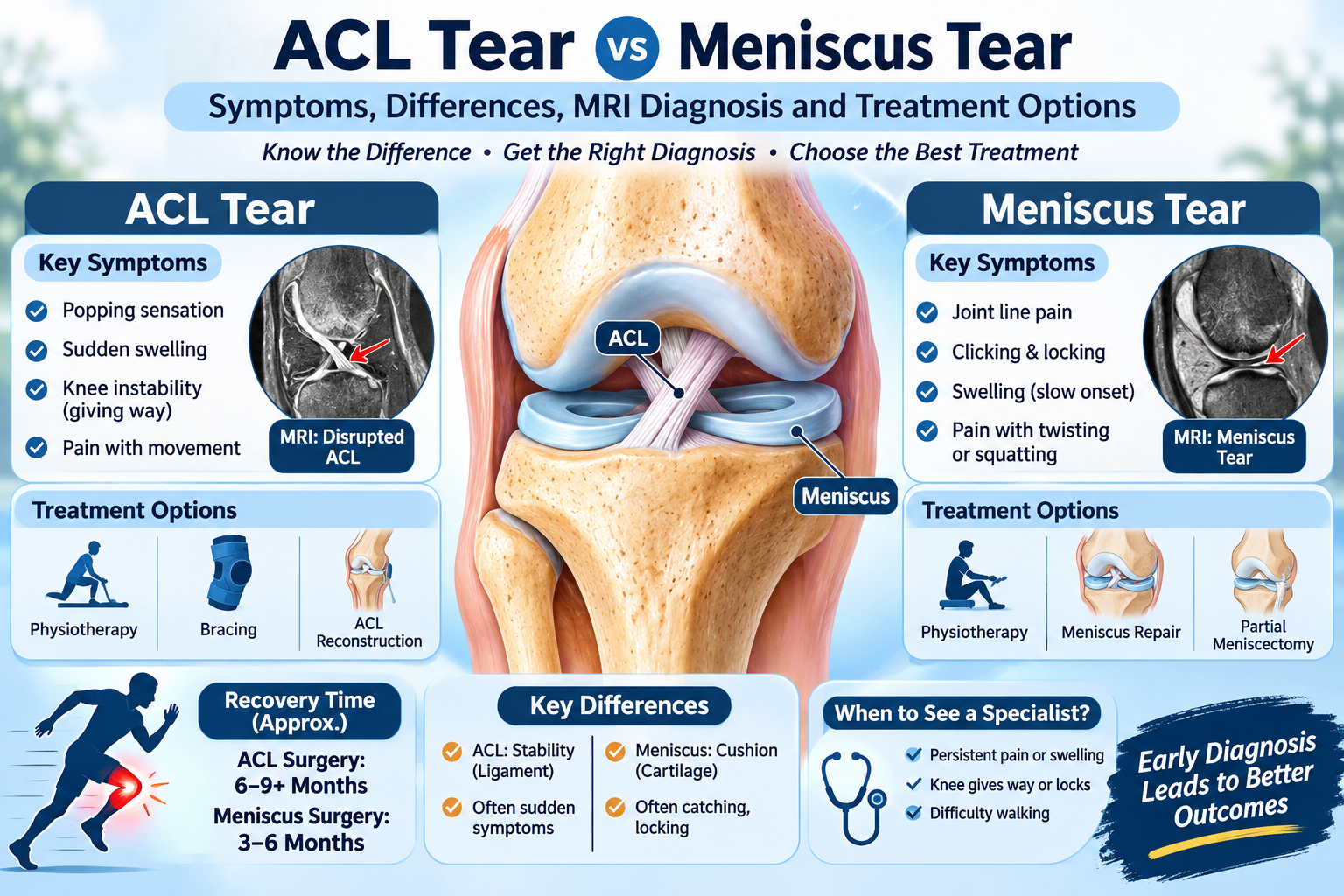
Here’s the short answer. The ACL is a ligament that keeps your knee stable, while the meniscus is a rubbery cushion that absorbs shock. An ACL injury usually brings a pop, quick swelling and a feeling that the knee gives way, while the meniscus tear symptoms lean towards catching, locking and pain when you twist or squat.
In this guide, you’ll learn how each injury happens, how to tell them apart, how MRI helps and how long recovery usually takes. If you’ve been searching for acl tear treatment options, you’ll find those here too.
What Is an ACL Tear?
People often ask, what is acl tear, and the simple answer is this: it’s an injury where the main stabilising ligament inside your knee is overstretched or torn, either partly or completely.
The anterior cruciate ligament, or ACL, is a strong band of tissue that runs diagonally through the middle of the knee. It connects the thigh bone (femur) to the shin bone (tibia), stops the shin from sliding too far forward, and keeps the knee steady when you pivot, cut or land from a jump. When this band gives way, doctors call it an acl tear.
What Causes It?
A knee acl tear usually happens in a split second. Common triggers include stopping suddenly, changing direction at speed, landing badly after a jump, or taking a direct blow to the knee. Football, basketball, kabaddi, badminton and skiing are typical settings.
Athletes aren’t the only ones affected, though. A slip on a wet floor, a missed step on the stairs or a road accident can injure the ligament too, and many cases of acl tear happen without any contact at all.
Partial vs Complete Injury
Doctors grade an anterior cruciate ligament tear by how much of the ligament is damaged. In a grade 1 injury, the ligament is stretched but still working. Grade 2 is a partial tear. In grade 3, the ligament is completely torn into two pieces. Partial injuries are less common than complete ones, and it’s the complete ruptures that most often leave the knee unstable.
What Is a Meniscus Tear?
So, what is the meniscus in the knee? It’s a C-shaped piece of tough, rubbery cartilage that sits between your thigh bone and shin bone. Think of it as a shock absorber that also spreads your body weight evenly across the joint.
Medial and Lateral Meniscus
The knee meniscus comes as a pair. The medial meniscus sits on the inner side of the knee, and the lateral meniscus sits on the outer side. The medial one gets injured more often because it’s held more firmly in place and carries more load.
What Causes It?
A knee meniscus injury can happen in two ways. In younger, active people, it usually follows a forceful twist while the foot is planted, often during sport. In people over 40, the cartilage slowly weakens with age, so even something as simple as standing up from a squat can cause a tear.
Kneeling, deep squatting and heavy lifting add to the risk. Floor sitting and squatting are part of everyday life for many people, and over time they put extra stress on a worn meniscus and can lead to a meniscus tear.
Types of Meniscal Tears
Not every tear looks the same. Surgeons commonly describe radial, horizontal, flap, longitudinal, bucket-handle and complex patterns, along with degenerative tears from long-term wear. The pattern, size and location all matter because they decide whether a meniscus tear can be repaired.
Location is a big deal. Only the outer rim of the cartilage has a good blood supply, so a knee meniscus injury in that zone has a much better chance of healing after repair than one deeper inside.
ACL Tear vs Meniscus Tear: Key Differences
Think of it this way. An ACL injury damages the rope that keeps your knee steady, while a meniscus tear damages the cushion that protects the joint surfaces. Because their jobs are different, the symptoms and treatment plans differ too.
| Feature | ACL Injury | Meniscus Injury |
| Injured structure | Ligament in the centre of the knee | C-shaped cartilage cushions (inner and outer) |
| Common causes | Sudden stop, pivoting, awkward landing, direct blow | Forceful twist, deep squat, kneeling, age-related wear |
| Pain location | Often deep inside or all around the knee | Usually along the inner or outer joint line |
| Swelling | Fast, often within hours | Slower, often over a day or two |
| Knee instability | Common; knee may give way | Less common; may feel unsteady due to pain or catching |
| Locking and clicking | Not typical unless the meniscus is also hurt | Common |
| Walking difficulty | Hard to bear weight at first; trouble turning or pivoting | Many can walk, but twisting, stairs and squatting hurt |
| MRI findings | Disrupted or missing ligament fibres, abnormal signal, bone bruising | Bright line through the cartilage, change in its shape |
| Treatment options | Rehab and bracing, or reconstruction | Rehab, repair or partial removal |
| Recovery time | Several months; often 6 to 9 months or more to return to sport after surgery | Weeks to months, depending on treatment |
ACL Tear Symptoms
The classic acl tear symptoms tend to show up right away, and most people remember the exact moment it happened.
A Popping Sensation
Many people feel or hear a pop at the time of injury. Sometimes it’s loud enough for teammates to notice. But not everyone gets a pop, so its absence doesn’t rule out an acl tear.
Sudden Swelling
Swelling usually builds quickly, often within a few hours, because the ligament has a good blood supply and bleeds into the joint. A knee that balloons soon after a twist is a classic sign of acl tear symptoms.
Knee Instability
Many people describe a feeling that the knee is about to buckle or give way, especially when turning or stepping sideways. This is often the symptom of a knee acl tear that sticks around long after pain and swelling settle.
Pain, Walking and Movement
Pain can be severe at first and then ease within days, which fools some people into thinking an acl tear has healed. Walking may be hard in the beginning, and the knee can feel stiff, with trouble fully bending or straightening it because of swelling.
Meniscus Tear Symptoms
The meniscus tear symptoms are often more gradual and tend to be mechanical, meaning the knee catches or blocks rather than gives way.
Knee Joint Pain
Pain is usually felt along the inner or outer edge of the knee, matching the side of the injured cartilage, which is a typical sign of meniscus tear symptoms in knee joints. It often sharpens when you twist, squat or climb stairs.
Swelling and Stiffness
Swelling typically develops slowly over a day or two rather than within hours. With a knee meniscus injury, the knee may feel tight and puffy, especially after sitting for a while.
Clicking and Locking
Some people notice clicking or catching inside the joint. If a torn flap of cartilage gets stuck between the bones, the knee can lock, meaning you can’t fully straighten it. A locked knee from a meniscus tear needs prompt medical attention.
Trouble Bending or Straightening
Difficulty bending or straightening fully, and pain with twisting, are common. Some people can keep walking and even playing for a while, which is why a knee meniscus injury is sometimes ignored for weeks.
How to Tell the Difference Between ACL and Meniscus Tear Symptoms
Typical meniscus tear symptoms in knee joints include catching, locking and pain on one side, while an ACL injury announces itself with a pop, rapid swelling and giving way.
A useful rule of thumb is that symptoms arriving instantly often point to the ACL, while symptoms building gradually often point to the meniscus. But it’s only a rule of thumb. The two injuries can happen together, so an acl tear and a meniscus injury can look very much alike.
That’s why a physical examination is so important. Orthopaedic specialists use hands-on tests such as the Lachman and anterior drawer tests to check ligament looseness, and the McMurray test and joint-line tenderness to check the cartilage. Self-diagnosis from online checklists isn’t reliable, even when your acl tear symptoms seem textbook.
MRI Diagnosis: ACL Tear vs Meniscus Tear
Once the examination points to an injury, MRI is the most useful imaging test for an acl tear or a torn meniscus because it shows soft tissues that X-rays can’t.
The Role of X-rays and Examination
X-rays don’t show ligaments or cartilage, but they’re still worth doing. They can rule out fractures, show early arthritis and sometimes reveal tiny bone chips that hint at an anterior cruciate ligament tear. Think of the examination as the starting point, the X-ray as a safety check, and the MRI as the detailed map.
How MRI Detects ACL Damage
On MRI, a healthy ACL looks like a smooth, dark band. A torn ligament may show disrupted or missing fibres, abnormal signal or an unusual angle. The scan also reveals bone bruising and helps separate a partial injury from a complete acl tear.
How MRI Identifies Meniscus Injuries
A healthy meniscus appears as dark, wedge-shaped structures, and a tear shows up as a bright line reaching the surface of the cartilage. When the scan is done, a meniscus tear knee report will often describe the pattern, such as radial, horizontal, flap or bucket-handle, and where in the meniscus it sits.
Why Specialist Interpretation Matters
MRI findings must be matched with your symptoms. Many adults over 40 show degenerative changes in the knee meniscus on MRI even when they have no knee pain at all. That’s why the report should be read by an orthopaedic specialist who has examined your knee, not judged on its own.
Can You Have Both an ACL Tear and a Meniscus Tear?
Yes, and it’s quite common. An acl tear often comes with a meniscus injury because the same twisting force can damage both. The outer (lateral) meniscus is more often hurt along with a fresh ACL injury, while the inner (medial) meniscus tends to get damaged later, when an unstable knee keeps slipping.
Sometimes the medial collateral ligament is hurt as well. Doctors call this combination the “unhappy triad,” and it makes a knee acl tear more complex to manage.
With a combined injury, you may notice the rapid swelling and giving way of an ACL injury along with the meniscus tear symptoms of locking and joint-line pain. Walking, bending and stairs can feel harder than with either injury alone.
MRI is especially valuable here because it shows both structures at once. When the ligament is reconstructed as part of acl ligament tear treatment, the surgeon will usually address the meniscus in the same operation, repairing it where possible. Recovery generally follows the longer ligament timeline, and protecting a repaired meniscus can add restrictions in the early weeks.
ACL Ligament Tear Treatment Options
The right acl ligament tear treatment depends on how badly the ligament is damaged, how unstable the knee feels, your age, your job and the activities you want to return to.
Rest, Ice and Swelling Control
In the first days after a knee acl tear, rest the knee and avoid anything that causes pain or giving way. Ice wrapped in a cloth for 15 to 20 minutes at a time, gentle compression and keeping the leg raised can help with swelling. Crutches may be needed for a short while, and a knee support can add comfort when your doctor advises it, but it doesn’t replace rehabilitation.
Physiotherapy
Physiotherapy is the foundation of acl ligament tear treatment, with or without surgery. The goals are to restore movement, calm swelling, strengthen the thigh, hip and calf muscles, and retrain balance and control. Many surgeons also like patients to complete some physiotherapy before surgery so the knee goes into the operation less stiff and swollen.
Non-Surgical Care
Non-surgical acl tear treatment can work well for people with partial injuries, those who don’t play pivoting sports, some older adults, and people whose knee feels stable after rehab. It means committed physiotherapy, some activity changes and sometimes a brace. The trade-off is that if the knee keeps giving way, repeated episodes can damage the meniscus and cartilage.
Is Surgery Necessary?
The question most patients ask is is surgery necessary for acl tear, and the honest answer is: not always. Surgery is usually recommended for young, active people who want to return to cutting and pivoting sports, for those whose knee gives way in daily life, and when other structures such as the meniscus are also damaged. A completely torn ACL doesn’t heal on its own because the torn ends don’t reconnect.
ACL Reconstruction and Its Benefits
When an anterior cruciate ligament tear needs surgery, reconstruction is usually done through keyhole (arthroscopic) surgery. The torn ligament is replaced with a graft, commonly taken from your own hamstring, patellar tendon or quadriceps tendon, or sometimes from a donor.
The main acl surgery benefits are a more stable knee, a better chance of getting back to pivoting sports and fewer giving-way episodes that could harm the meniscus and cartilage. Surgery isn’t risk-free, since infection, stiffness, blood clots and graft failure are possible, and it only works well when paired with serious rehabilitation.
Knee Meniscus Tear Treatment Options
Choosing the right knee meniscus tear treatment depends on the tear pattern, its location, your age, your symptoms and how active you are. Many tears, especially small or degenerative ones, don’t need surgery.
Conservative Treatment
This usually means relative rest, ice, avoiding deep squatting and twisting for a while, and gradually returning to normal activity. Many people see their symptoms settle over time, which is why knee meniscus tear treatment often starts without surgery.
Physiotherapy
Strengthening the thigh and hip muscles takes load off the joint and improves control. It’s often the first step even for a meniscus tear that may eventually need surgery.
Medication Under Medical Supervision
Painkillers or anti-inflammatory medicines can ease pain and swelling in the short term, but the choice and duration should come from your doctor, especially if you have stomach, kidney or heart concerns. Medicines only treat the symptoms of a knee meniscus injury. They don’t repair the tear.
Meniscus Repair
In a repair, the surgeon stitches the torn edges together so the cartilage can heal. This works best for a meniscus tear in the outer, blood-rich zone, particularly in younger patients, and it helps preserve the cushion for the long term.
Partial Meniscectomy
Here the surgeon trims away only the damaged portion and leaves healthy tissue behind. It’s an option when a meniscus tear can’t be repaired, for example in the poorly supplied inner zone or in degenerative cases. Recovery is quicker, but removing cartilage may raise the chance of arthritis later in life.
What Affects the Decision?
- Tear pattern and location
- Your age and activity level
- Whether the knee locks or catches
- Whether the ACL or other structures are also injured
- Existing arthritis in the joint
- How you respond to physiotherapy
ACL Tear Recovery Time
Everyone wants a number for acl tear recovery time, but it genuinely varies. It depends on whether you have surgery, how severe the injury is, your general fitness and how faithfully you follow rehab.
Recovery Without Surgery
With non-surgical acl tear treatment, people usually spend a few months in structured rehab to rebuild strength and stability, then keep up their exercises. Whether you can return to sport depends on how stable the knee feels and on your physiotherapist’s testing, and if your sport involves a lot of pivoting, the knee may not feel reliable enough.
Recovery With Surgery
For acl tear recovery time with surgery, many people walk without crutches within a couple of weeks and are back at desk work within a few weeks. Running usually starts at around three to four months in many programmes, if strength and control allow. Return to sport commonly takes six to nine months or longer. A survey of American Orthopaedic Society for Sports Medicine surgeons found that most cleared athletes for pivoting sports between seven and ten months after surgery.
Rehabilitation Stages
Every programme is different, but the stages of acl tear recovery time generally look like this:
- Early weeks: control swelling, regain full straightening, walk normally.
- Strength phase: build thigh and hip strength, improve balance, start cycling or swimming as advised.
- Running and agility phase: straight-line running, then controlled change of direction.
- Return-to-sport phase: sport-specific drills, jump and hop testing, gradual match fitness.
Factors and Return to Sport
Age, the type of graft, other injuries such as a torn meniscus, how consistent you are with rehab and your muscle strength all play a part. Time alone isn’t the test, since surgeons and physiotherapists also look at strength compared with your other leg, hop tests and your confidence. Rushing back too early raises the chance of re-injury after an acl tear.
Meniscus Tear Recovery Time
As with the ligament, meniscus tear recovery time isn’t one-size-fits-all.
Recovery Without Surgery
Many people with small or degenerative tears feel much better within a few weeks to a few months of rehab, though some stiffness or an occasional ache can linger. If locking or persistent pain continues after a proper trial of physiotherapy for a meniscus tear, your doctor may reconsider surgery.
Recovery With Surgery
The meniscus tear recovery time with surgery depends mostly on which operation you have, as the comparison below shows.
Repair vs Partial Meniscectomy
| Partial Meniscectomy | Meniscus Repair | |
| Crutches | A day or two, or none | Often up to about 6 weeks, sometimes with a brace |
| Back to normal walking | Often 1 to 2 weeks | Often 4 to 8 weeks |
| Return to sport | Often 4 to 8 weeks | Often 3 to 6 months |
| Long-term cushioning | Permanently reduced | Preserved if the repair heals |
Complex repairs, such as root repairs, can need even longer protection from weight-bearing and up to six to nine months for full recovery. These are general ranges for meniscus tear recovery time with surgery, so your surgeon’s plan comes first.
Rehabilitation and Restrictions
After a repair of a knee meniscus injury, bending beyond roughly 90 degrees, deep squatting, twisting and pivoting are usually restricted for the first weeks to protect the stitches. After a trimming procedure, rehab is shorter and activity can build up more quickly.
Factors Affecting Recovery
The tear type and location, whether it was repaired or trimmed, your age, any arthritis, other injuries (especially the ACL) and how well you stick to rehab all influence your meniscus tear recovery time.
When Should You See an Orthopaedic Specialist?
Don’t wait for a sore knee to sort itself out. See a specialist if you suspect a knee meniscus injury or ligament damage and notice any of these:
- You can’t put weight on the leg
- Your knee is locked and won’t fully straighten
- Swelling is severe or appears soon after the injury
- The knee gives way repeatedly
- The knee looks deformed
- Pain hasn’t improved after a week or two
Go to a hospital immediately if the foot becomes numb, pale or cold, or if the calf becomes very swollen and painful after an injury. Early assessment of an acl tear or torn meniscus helps prevent further damage to the cartilage and ligaments.
Frequently Asked Questions
1. What is the main difference between an ACL tear and a meniscus tear?
The ACL is a ligament that stabilises the knee, while the meniscus is cartilage that cushions it. An acl tear mostly causes instability, and a torn meniscus mostly causes catching, locking and pain with twisting.
2. How do ACL tear symptoms differ from meniscus tear symptoms?
An ACL injury typically brings a pop, swelling within hours and giving way. In short, acl tear symptoms are sudden and unstable, while a torn meniscus tends to cause slower swelling, joint-line pain, clicking and locking.
3. Can you walk with an ACL tear?
Often yes, once the first few days pass, especially in a straight line. But the knee may buckle when you turn or take stairs, so being able to walk doesn’t mean the ligament is fine, even with a knee acl tear.
4. Can you walk with a meniscus tear?
Many people can, though it may hurt. If a torn piece blocks the joint, a meniscus tear can lock the knee and make walking difficult.
5. Can an ACL tear heal without surgery?
A completely torn ligament doesn’t knit back together on its own. Some people still do well through rehab because the surrounding muscles take over much of the stabilising work, and partial injuries may settle with acl tear treatment.
6. Is surgery necessary for an ACL tear?
Not always. The answer to is surgery necessary for acl tear depends on your age, activity and symptoms. It’s usually advised for active people who want to return to pivoting sports, for those with ongoing instability and for combined injuries.
7. Does every meniscus tear require surgery?
No. Many small or degenerative tears improve with rest and physiotherapy. Knee meniscus tear treatment leans towards surgery when the knee locks or symptoms persist.
8. Can an MRI detect both ACL and meniscus tears?
Yes, MRI shows both structures well. Still, the report should always be read alongside your examination, since a knee meniscus can show changes even in people without symptoms.
9. Can you have an ACL tear and meniscus tear at the same time?
Yes. Combined injuries are common after twisting accidents, and an anterior cruciate ligament tear with a torn meniscus is usually treated together.
10. How long does an ACL tear take to recover?
The acl tear recovery time after surgery, for return to sport, is commonly about six to nine months or more. Without surgery, rehab usually takes a few months, and the outcome varies from person to person.
11. How long does a meniscus tear take to recover?
The meniscus tear recovery time is often a few weeks after a trimming procedure and about three to six months after a repair. Non-surgical recovery can take weeks to months.
12. Which injury is more serious, an ACL tear or a meniscus tear?
Neither is simply “worse.” An ACL injury is often more disabling for active people because of instability, while a neglected knee meniscus injury can contribute to long-term cartilage wear. Seriousness depends on the tear, your knee and your goals.
Conclusion
The ACL keeps your knee stable and the meniscus cushions it, so the two injuries feel different, get investigated differently and are treated differently. Because they often occur together, a proper examination and an MRI read by an orthopaedic specialist are the safest way to confirm an acl tear or a torn meniscus.
Treatment is never one-size-fits-all. It depends on the tear, your age, your activity level and your goals, and recovery timelines are only guides. If your knee has been injured, get it checked early, because waiting out a meniscus tear can sometimes make it worse.