
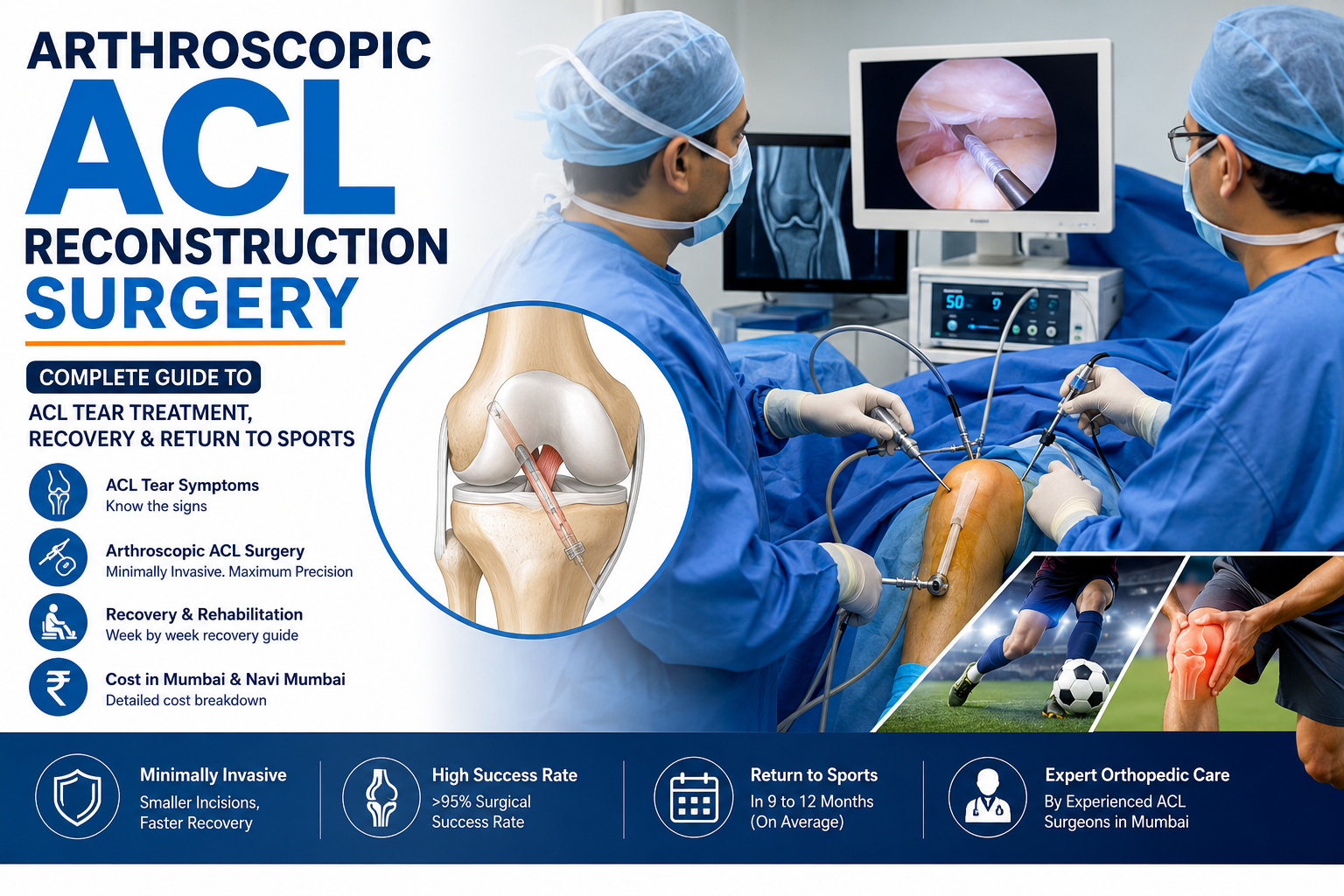
Every year, thousands of patients across India walk into an orthopedic clinic after a single bad moment on a football field, a missed step on the stairs, or an awkward landing from a jump. Many of them are dealing with an ACL tear and have no idea what comes next. Questions pile up fast. Do I need surgery? How long is recovery? What does arthroscopic ACL reconstruction actually involve? This guide answers all of those questions plainly. If you are searching for ACL surgery options in Mumbai or Navi Mumbai, or you simply want to understand your diagnosis before your next appointment, you are in the right place.
ACL injuries are not just a sports problem. Yes, cricket players, football athletes, and kabaddi players are commonly affected. But so are everyday people who twist their knee getting out of a car or step off a curb wrong. The ACL is one of the most stressed ligaments in the human body, and when it tears, the knee loses its ability to stay stable under load.
What follows is a thorough breakdown of the condition, the procedure, the recovery, the cost, and how to find the right surgeon. Nothing is glossed over.
What Is the ACL and What Does It Actually Do?
The anterior cruciate ligament runs diagonally through the center of your knee, connecting the bottom of the femur (thigh bone) to the top of the tibia (shin bone). Its job is to stop the tibia from sliding forward under the femur and to control the rotational movement between the two bones.
Think of it as the knee’s internal stabilizing cable. When it is intact, you can cut, pivot, land from a jump, or change direction without the knee collapsing. When it is torn, those same movements become either impossible or dangerous.
The ACL has very limited blood supply, which means it cannot repair itself after a complete rupture. This is why ACL tear treatment in active patients almost always ends with surgery rather than rest alone. The ligament does not grow back. It has to be replaced.
| Anatomy FactThe ACL is about 3.5 cm long and roughly 1 cm wide. Despite being small, it handles forces several times your body weight during jumping and pivoting activities. |
Common Causes of ACL Injuries
Most ACL tears happen without any contact at all. A player decelerates sharply, lands awkwardly, or pivots with the foot planted, and the ligament gives way. Direct contact to the knee (like a tackle) accounts for only about 30% of ACL injuries. The rest happen through movement alone.
Sports that carry the highest risk in India include:
• Football and futsal (cutting and pivoting under fatigue)
• Cricket (sudden sprinting and fielding dives)
• Kabaddi (explosive direction changes and grappling)
• Basketball and volleyball (jumping and landing mechanics)
• Badminton (lateral lunge movements at high speed)
• Skiing and snowboarding (for those who travel abroad)
Non-sport causes are also common. Falling from a height, twisting the knee in a road accident, or stepping into an uneven surface can all cause an ACL tear. The ligament does not distinguish between a sporting tackle and a household fall.
Who Is More at Risk?
Women are roughly 2 to 8 times more likely than men to sustain an ACL injury. Biomechanical differences in hip width, quadriceps angle, and knee alignment, combined with different muscle activation patterns during landing, are the main reasons. Young athletes between 15 and 25 are the most commonly affected population overall.
Other risk factors include:
• Previous ACL injury on the same or opposite knee
• Weak hamstring to quadriceps strength ratio
• Poor landing mechanics and jump training
• Playing on artificial turf, which has higher traction than grass
• Returning to sport too quickly after a prior knee injury
ACL Tear Symptoms: What Does It Feel Like?
Patients often describe the injury moment with striking clarity. The ACL injury symptoms are usually hard to miss, even if the exact diagnosis is not immediately obvious.
At the Time of Injury
• A loud pop or crack heard or felt inside the knee
• Sudden sharp pain that may ease within hours (which can mislead patients into thinking the injury is minor)
• Rapid swelling of the knee, usually within 2 to 4 hours, caused by bleeding inside the joint (haemarthrosis)
• Immediate loss of confidence in the knee, a feeling that it cannot be trusted
In the Hours and Days After
• The knee feels unstable, wobbly, or gives way when walking or trying to turn
• Difficulty fully straightening or bending the knee
• Tenderness along the joint line
• Bruising that develops around the knee over 24 to 48 hours
In the Weeks After (If Untreated)
• Persistent instability episodes, where the knee buckles without warning
• Reduced ability to run, pivot, or play sport
• Gradual development of secondary damage to the meniscus if the instability continues
| ImportantA knee that stops swelling and becomes less painful over a few weeks does not mean the ACL has healed. Pain reduction is common. Instability remains, and the damage to the joint continues quietly. Get an MRI confirmed diagnosis, not just a clinical assessment. |
How Is an ACL Tear Diagnosed?
Diagnosis starts with a clinical examination. Your orthopedic specialist will check for swelling, tenderness, and range of motion. Two specific manual tests are used to assess ligament stability: the Lachman test and the anterior drawer test. Both involve gently moving the tibia forward relative to the femur. A positive result suggests ACL laxity.
Imaging is then ordered to confirm the diagnosis and assess the full extent of the injury.
• X-ray: Rules out bone fractures. X-rays do not show ligaments.
• MRI (Magnetic Resonance Imaging): The definitive investigation for ACL tears. It shows the ligament directly and also detects any associated meniscus tears or cartilage damage. Most surgeons will not plan surgery without a current MRI.
• Ultrasound: Occasionally used but less reliable than MRI for ACL injuries.
MRI cost for the knee in Mumbai and Navi Mumbai typically ranges from Rs. 3,000 to Rs. 4,000 at most diagnostic centres. Some hospitals bundle the scan cost into the surgical package.
When Is ACL Surgery Needed? And When Can It Wait?
Not every ACL injury requires immediate surgery. The decision depends on the severity of the tear, your age, your activity level, and whether there is associated damage to the meniscus or other ligaments. For younger, active patients with a complete tear and a sports injury to the knee, surgery is almost always the right call. For older, less active patients, physiotherapy and bracing may be sufficient.
Surgery Is Usually Recommended When:
• You have a complete ACL rupture confirmed on MRI
• You want to return to sport or physically demanding work
• The knee is functionally unstable despite conservative management
• There is associated meniscus damage that needs surgical repair
• You are under 40 with long-term functional goals for the knee
• The knee has had multiple instability episodes causing secondary cartilage wear
Surgery May Be Delayed When:
• The initial swelling is severe and range of motion is restricted (wait 2 to 6 weeks for pre-operative physiotherapy)
• The tear is partial and the knee is clinically stable
• Overall health conditions make surgery risky
• The patient is elderly and has low activity demands
On timing: most surgeons recommend against operating on an acutely swollen knee. A short period of pre-operative physiotherapy, usually 2 to 6 weeks, reduces swelling, restores range of motion, and improves muscle control before surgery. This preparation period is associated with better outcomes.
On delay: waiting too many months is also not ideal. An unstable knee accumulates damage to the meniscus and cartilage with every episode of giving way. By the time some patients finally reach surgery, they need more complex repairs and face a longer recovery.
Arthroscopic ACL Reconstruction: The Procedure Explained
Arthroscopic ACL reconstruction is the standard surgical treatment for a torn ACL. It is a minimally invasive procedure performed through small incisions using a camera and specialized instruments. The surgeon does not cut the knee open. Instead, a thin tube with a camera (arthroscope) is inserted through a small portal, sending real-time video to a monitor so the surgeon can work with precision inside the joint.
The torn ligament cannot be sewn back together. It is replaced with a tissue graft, which over time becomes incorporated into the bone tunnels and functions as a new ACL.
Step-by-Step: What Happens During Surgery
1. Anaesthesia is administered. Most patients receive general anaesthesia. Some receive a regional nerve block, which provides excellent post-operative pain control.
2. The patient is positioned and the leg is prepared. A tourniquet may be applied to reduce bleeding.
3. Two to three small incisions (portals) are made around the knee. The arthroscope enters through one, instruments through the others.
4. The surgeon performs a complete diagnostic arthroscopy, inspecting the menisci, cartilage, and other ligaments. Any meniscus tears found at this stage are repaired.
5. The torn ACL remnant is removed using a shaver device.
6. The graft is harvested (if using the patient’s own tissue) through a slightly larger incision.
7. Bone tunnels are drilled in the femur and tibia at precise anatomical positions to place the graft correctly.
8. The graft is threaded through the tunnels and positioned to replicate the original ACL.
9. The graft is secured at both ends using fixation screws or buttons. Knee motion is checked to verify correct tension.
10. All incisions are closed with sutures. A compression bandage and knee brace are applied.
The procedure takes 60 to 90 minutes for a straightforward reconstruction. If meniscus repair is also done, it may take longer. It is an outpatient procedure in most cases, meaning you go home the same day.
| Surgical DetailThe arthroscope camera transmits a magnified, high-definition view of the inside of the knee to a monitor. The surgeon operates while watching this screen. This is why arthroscopic surgery requires specific training beyond general orthopaedic skills. |
Graft Options for ACL Reconstruction: What Are the Choices?
The choice of graft tissue is one of the most debated topics in ACL surgery. There is no single answer that fits every patient. Your surgeon will recommend a graft based on your age, activity level, sport, and anatomy.
1. Hamstring Tendon Autograft (Your Own Tissue)
Two tendons from the back of your thigh (gracilis and semitendinosus) are harvested and folded to create a strong multi-strand graft. This is the most commonly used option across India for active and athletic patients.
• Advantages: Smaller harvest incision, less anterior knee pain post-op, good long-term outcomes
• Considerations: The hamstring takes time to recover strength. Some studies show slightly higher re-tear rates in young, high-demand athletes compared to patellar tendon grafts.
2. Patellar Tendon Autograft (Bone-Patellar Tendon-Bone)
A central strip of the patellar tendon with bone plugs at each end is used. The bone-to-bone healing is considered reliable and many surgeons regard this as the gold standard for high-demand athletes.
• Advantages: Strong bone-to-bone fixation, faster graft integration, preferred by some surgeons for contact sport athletes
• Considerations: Anterior knee pain with kneeling is common in the first 6 to 12 months. Slightly higher risk of patellar tendon problems post-harvest.
3. Quadriceps Tendon Autograft
A newer option gaining popularity, especially for younger patients. The graft is taken from the quadriceps tendon above the kneecap. Recent studies comparing graft types in younger patients have shown favorable outcomes.
• Advantages: Large, robust graft with good mechanical properties
• Considerations: Larger harvest site than hamstring, though the quad recovers well with physiotherapy
4. Allograft (Donor Tissue)
Tissue from a cadaver donor is used instead of harvesting from the patient. This avoids a second surgical site and harvest-site pain.
• Advantages: No donor site morbidity, suitable for older or less active patients, useful for revision surgeries
• Considerations: Longer integration time into bone, slightly weaker initial strength, not recommended for young high-demand athletes due to higher re-tear rates
Benefits of Arthroscopic ACL Reconstruction
Compared to older open surgical techniques, arthroscopic knee surgery offers patients significantly better experiences before, during, and after the procedure.
• Minimally invasive: Two to three small incisions instead of a large knee opening
• Reduced blood loss and lower infection risk compared to open surgery
• Less damage to surrounding muscles and soft tissue
• Shorter hospital stay: Most patients go home the same day
• Faster return to walking and early physiotherapy exercises
• Better cosmetic outcome with minimal visible scarring
• Surgical success rates consistently above 95% in experienced hands
• Ability to diagnose and repair additional damage (meniscus, cartilage) in the same operation
• The surgeon can see inside the joint clearly at high magnification, improving precision
Risks and Complications of ACL Surgery
Every surgical procedure carries risk. ACL reconstruction is a low-risk operation in experienced hands, but patients should know what to watch for.
| Complication | What You Should Know |
| Infection | Rare but possible. Signs include increasing redness, warmth, and fever after surgery. Treated with antibiotics or, rarely, re-operation. |
| Deep vein thrombosis (blood clot) | More common if early mobilisation is delayed. Your surgeon will advise blood thinners and early walking to reduce risk. |
| Stiffness / reduced range of motion | Happens when physiotherapy is delayed or insufficient. Starting rehab promptly in the first 2 weeks is the best prevention. |
| Graft failure / re-tear | Affects roughly 5-10% of patients, more often in young athletes returning too early or to high-contact sport. Revision surgery is possible but harder. |
| Anterior knee pain | More common with patellar tendon grafts. Usually resolves within 6 to 12 months with physiotherapy. |
| Numbness around the incision | Minor nerve irritation near the harvest site. Usually temporary and resolves over weeks to months. |
| Knee stiffness (arthrofibrosis) | Scar tissue buildup if early movement is not maintained. Prevented by starting range-of-motion exercises in the first week post-op. |
If a graft fails, revision ACL reconstruction is possible but more complex. Success rates for revision surgery are lower than for a first-time reconstruction. This is the clearest reason why the first surgery should be done well, by an experienced surgeon, followed by a full rehabilitation program.
How to Prepare for ACL Reconstruction Surgery
Preparation begins the moment the decision to operate is made. Patients who show up to surgery with a mobile, less swollen knee, strong muscles, and good range of motion tend to recover faster.
Pre-Operative Physiotherapy (Prehab)
Most surgeons recommend 2 to 6 weeks of prehab before the operation. This involves exercises to reduce swelling, restore knee extension (ability to fully straighten the leg), and strengthen the quadriceps. A knee that goes into surgery with full extension and strong quads comes out of surgery ahead.
Investigations Required Before Surgery
• MRI of the knee (usually already done for diagnosis)
• Blood tests (complete blood count, blood group, clotting profile)
• Chest X-ray and ECG for patients above 40 or with other health conditions
• Anaesthesia review if there are any respiratory or cardiovascular concerns
What to Stop Before Surgery
• Blood-thinning medications (aspirin, clopidogrel) should be stopped 5 to 7 days before surgery, as advised by your doctor
• Smoking significantly delays healing and increases infection risk. Stop at least 4 weeks before if possible
• Avoid anti-inflammatory drugs like ibuprofen in the week before surgery unless specifically prescribed
Practical Preparation
• Arrange for someone to drive you home from the hospital on surgery day
• Prepare a recovery space at home: a chair that allows you to elevate the leg, ice packs ready, medications filled
• If you live in a multi-floor home, plan to stay on the ground floor for the first 2 weeks
• Pre-fill your physiotherapy appointment for the week after discharge before you go in for surgery
ACL Reconstruction Recovery Time: Week by Week
ACL reconstruction recovery time is frequently underestimated. Most patients return to full, unrestricted sporting activity between 9 and 12 months. Skipping stages or rushing the timeline is the most common reason for re-injury. Here is a realistic week-by-week breakdown of what to expect.
| Phase | What Happens & What You Do |
| Week 1-2(Immediate Post-Op) | Pain and swelling are highest in this phase. Keep the leg elevated whenever resting. Ice the knee regularly (20 minutes on, 20 off). Crutches are used for all walking. Begin gentle range-of-motion exercises (heel slides, quad sets). Most patients can start stationary cycling within the first week. Sutures are usually removed at 10 to 14 days. |
| Week 3-6(Early Rehab) | Swelling reduces significantly. Crutch use is gradually phased out. Full weight-bearing walking begins. Straight-leg raises, mini squats, and cycling continue. The knee should be approaching full extension at 6 weeks. Attending physiotherapy sessions 2 to 3 times per week is typical. |
| Week 6-12(Strength Phase) | Progressive resistance exercises for quads, hamstrings, and calf muscles. Balance and proprioception training (single-leg stands, balance board). Swimming is usually permitted at this stage. No running yet for most patients. |
| Month 3-6(Functional Phase) | Jogging may begin around month 4 to 5 if strength tests are satisfactory. Continued strengthening with gym-based exercises. Sports-specific movements begin in a controlled setting. The graft is still maturing inside the bone tunnels during this phase, even if the knee feels strong. |
| Month 6-9(Advanced Sports Rehab) | Running, lateral movements, change-of-direction drills, and jumping mechanics under supervision. Return to non-contact training in your sport. Psychological readiness is assessed alongside physical readiness. |
| Month 9-12(Return to Sport) | Full return to contact sport after passing objective functional tests: limb symmetry in strength testing, hop tests, and sport-specific performance assessments. Most surgeons require at least 90% symmetry between the operated and non-operated leg before clearing contact sport. |
| Key Point on RecoveryThe graft is at its weakest between 6 and 12 weeks after surgery, when the original graft tissue is being remodelled by the body into new ligament. The knee may feel strong during this window, but the biology is not ready. This is why return-to-sport decisions should be based on tests, not on how the knee feels. |
Physiotherapy After ACL Surgery: The Non-Negotiable Part
Physiotherapy after ACL surgery is not optional. The surgery creates the structural foundation. Physiotherapy builds the function on top of it. Patients who do not follow a structured rehab program consistently have worse outcomes, higher re-injury rates, and a slower return to sport.
Early Phase Goals (Week 1 to 6)
• Reduce swelling and pain
• Restore full knee extension (inability to fully straighten the leg is a major early complication to avoid)
• Regain normal walking pattern without a limp
• Activate and strengthen the quadriceps muscle
Middle Phase Goals (Month 2 to 5)
• Progressive strength training for all muscle groups around the knee
• Improve balance and proprioception (the knee’s ability to sense its position)
• Begin low-impact cardiovascular activity (cycling, swimming, elliptical)
• Address any range-of-motion limitations
Late Phase Goals (Month 6 Onwards)
• Running mechanics and agility
• Jump landing technique to reduce re-injury risk
• Sport-specific movement patterns under coaching supervision
• Psychological readiness and confidence assessment
ACL Rehab Exercises You Can Expect
Your physiotherapist will guide ACL rehab exercises specific to your stage of recovery. Common exercises across the rehab timeline include:
• Weeks 1-2: Heel slides, quad sets, straight-leg raises, ankle pumps
• Weeks 3-6: Mini squats, step-ups, stationary cycling, balance board standing
• Month 2-3: Leg press, hamstring curls, single-leg balance, swimming
• Month 4-6: Jogging on flat surface, lateral band walks, box step-downs
• Month 6+: Running, cutting drills, jump and land training, sport-specific patterns
Physiotherapy sessions typically run 2 to 3 times per week for the first 3 months, then drop to once a week with daily home exercises as you progress. The total cost of physiotherapy for a full ACL rehab course in Mumbai ranges from Rs. 15,000 to Rs. 40,000 depending on the clinic and frequency of sessions.
Return to Sports After ACL Surgery: What the Research Says
Return to sports after ACL surgery is not a date on a calendar. It is a set of criteria that needs to be met. Research consistently shows that patients who return to sport based on time alone, rather than functional testing, have significantly higher rates of re-injury.
Most sports medicine specialists now use a criteria-based return-to-sport protocol:
• Quadriceps and hamstring strength at least 90% of the opposite, uninjured leg
• Hop test performance (single-leg hop, triple hop, crossover hop) at or above 90% symmetry
• Psychological readiness scale scores above threshold
• Completion of sport-specific agility drills without pain or instability
• Minimum 9 months from surgery, regardless of how good the knee feels
Studies show roughly 80 to 90% of ACL reconstruction patients return to sport. About 65% return to their pre-injury competitive level. The re-tear rate is around 15 to 25% in young athletes who return to pivoting sports, which is why thorough rehabilitation and not rushing the timeline matters.
For athletes in cricket, football, and kabaddi in particular, a structured neuromuscular training program focused on landing and cutting mechanics reduces re-injury risk significantly even after return to full contact sport.
ACL Reconstruction Cost in India: Mumbai and Navi Mumbai
The ACL reconstruction cost in India varies considerably based on the hospital, the surgeon’s experience, the type of graft used, and whether additional procedures like meniscus repair are needed. Here is a practical breakdown for patients looking at ACL surgery cost in Mumbai and Navi Mumbai.
| Component | Approximate Cost (INR) |
| ACL Reconstruction only (no meniscus repair) | Rs. 1,20,000 to Rs. 1,60,000 |
| ACL Reconstruction with meniscectomy | Rs. 1,40,000 to Rs. 2,00,000 |
| ACL Surgery in Navi Mumbai (general estimate) | Rs. 1,40,000 to Rs. 2,00,000 |
| ACL Surgery in Mumbai (premium private hospitals) | Rs. 2,00,000 to Rs. 4,00,000 |
| Pre-op investigations (MRI, blood tests, ECG) | Rs. 5,000 to Rs. 10,000 |
| Physiotherapy (full 6 to 9 month course) | Rs. 15,000 to Rs. 40,000 |
| Knee brace and post-op supplies | Rs. 3,000 to Rs. 8,000 |
| Total estimated range (surgery + rehab) | Rs. 1,50,000 to Rs. 4,50,000 |
These numbers are estimates. Your surgeon and hospital will provide a detailed cost breakdown before the procedure. Most health insurance plans in India cover ACL reconstruction as a medically necessary procedure after documented injury. Check your policy for the waiting period clause and room rent limits before choosing a hospital.
Government hospitals and medical college hospitals in Mumbai offer the procedure at significantly lower costs but with longer waiting times. For those without insurance who need affordable options, these are worth exploring.
How to Find the Best ACL Surgeon in Navi Mumbai or Mumbai
Choosing the right surgeon for ACL reconstruction in Navi Mumbai or anywhere in Mumbai is not just about reputation. It is about matching the right skill set to your specific needs. Here is what actually matters:
What to Look For
• Fellowship training in sports medicine or knee arthroscopy, not just a general orthopaedic background
• Experience with arthroscopic ACL reconstruction specifically: ask how many they do per year
• Clear explanation of graft options and the reasoning behind their recommendation for your case
• A structured post-operative physiotherapy protocol with clear return-to-sport milestones
• Willingness to answer your questions about risks, costs, and recovery without rushing you
Questions to Ask Your Surgeon
• How many ACL reconstructions do you perform each year?
• Which graft do you recommend for my case, and why?
• Do you have a dedicated physiotherapy team or protocol I will follow after surgery?
• What are the return-to-sport criteria you use, and when do you typically clear patients?
• What happens if the graft fails, and how would you manage that?
• Does your hospital have dedicated sports injury management infrastructure?
For knee ligament injury treatment in Mumbai, hospitals and orthopaedic clinics with dedicated sports injury units are generally better equipped than general orthopaedic departments. Surgeons associated with sports teams, academies, or sports medicine certification bodies tend to see a higher volume of ACL cases.
Life After ACL Reconstruction: Long-Term Outcomes
Most patients who go through ACL reconstruction and complete rehabilitation report a return to normal life and sports. The knee is not the same as a native, uninjured knee, but for the vast majority, it is functional enough to do everything they want to do.
Long-Term Success Rates
• Over 90% of patients have a stable knee that does not give way in daily life
• 80 to 90% of active patients return to their sport
• Graft survival rate at 10 years is above 85% in patients who follow rehabilitation completely
• Re-tear risk is highest in young athletes returning to high-demand sport before the 9-month mark
What About Arthritis?
ACL reconstruction reduces but does not eliminate the long-term risk of knee osteoarthritis. Studies show that a knee left unstable without reconstruction develops arthritis faster than a reconstructed knee. However, the injury itself causes some cartilage stress regardless of treatment. Maintaining healthy body weight, doing regular lower-limb strength training, and not overloading the knee in the years after surgery all help reduce arthritis risk.
Playing Sport for Life
Many patients return to full competitive sport and continue playing for years. Professional athletes, recreational club players, and ordinary active adults all have good outcomes after well-performed ACL reconstruction. The key is completing the rehabilitation and not treating the 9-month clearance as the finish line. Ongoing strength and conditioning after return to sport reduces long-term risk significantly.
Frequently Asked Questions
Can the ACL heal without surgery?
A partial ACL tear with a clinically stable knee may be managed conservatively in some patients, especially older or less active individuals. A complete tear will not heal on its own. The ligament lacks the blood supply for self-repair. Without reconstruction, the knee remains unstable and progressively damages the meniscus and cartilage.
How long before I can walk normally after ACL surgery?
Most patients walk without crutches by 3 to 6 weeks. Walking with a normal gait pattern, without a limp, is typically achieved by 6 to 8 weeks for straightforward reconstructions.
Is the surgery done under general anaesthesia?
Most ACL reconstructions in India are performed under general anaesthesia. Some surgeons use a spinal block combined with a local nerve block (epidural or femoral nerve block). The anaesthesia approach is discussed with you before surgery based on your health and the surgeon’s preference.
Will I need a brace after surgery?
Some surgeons use a hinged knee brace for the first 4 to 6 weeks to protect the graft during early healing. Others do not routinely brace. Whether you need one depends on your surgeon’s protocol and whether a meniscus repair was done at the same time.
Can I drive after ACL surgery?
For the right knee, driving is usually not permitted until you are off crutches and have adequate strength and reaction time, typically 6 to 8 weeks for automatic vehicles and longer for manual transmission. For the left knee in automatic vehicles, patients sometimes return sooner, but your surgeon and physiotherapist will give you a specific clearance.
What is the re-tear rate after ACL reconstruction?
Re-tear rates in adults are roughly 5 to 10%. In young athletes under 25 who return to pivoting sports, rates of 15 to 25% have been reported in some studies. This is why the 9-month minimum and objective functional testing before return to sport are so strongly recommended.
Can I prevent a future ACL injury after returning to sport?
Neuromuscular training programs, focused on landing mechanics, hip and hamstring strengthening, and proper deceleration technique, have been shown to reduce ACL re-injury rates by 50 to 60%. These are worth continuing well beyond the formal end of physiotherapy.
Is ACL surgery covered by health insurance in India?
Yes, in most cases. Health insurance plans in India typically cover ACL reconstruction when it is medically necessary following a documented injury, supported by an MRI report. Check your policy for sub-limits on room rent and any waiting period conditions before you choose your hospital.
When Should You See an Orthopedic Specialist?
Do not wait for symptoms to resolve before getting assessed. Here are the situations where you should book a consultation without delay:
• A pop and immediate swelling after a sports injury or fall
• A knee that gives way, buckles, or feels loose during normal walking
• Persistent swelling more than 2 weeks after an injury
• You have an MRI report showing an ACL tear and want to understand your options
• You previously had an ACL injury and feel new instability
• You are planning a return to sport and want a knee assessment before resuming
Early consultation means early diagnosis. Early diagnosis means you make the decision about ACL injury treatment on your terms, not in crisis after the meniscus has also been damaged. An appointment with an orthopedic specialist does not commit you to surgery. It gives you the information you need to decide what is right for your knee and your life.
| Find an ACL Specialist in Navi MumbaiIf you are looking for the best ACL surgeon in Navi Mumbai or Mumbai, look for orthopedic surgeons with specific arthroscopic sports surgery training, dedicated sports injury clinics, and structured post-operative physiotherapy programs. Ask for a consultation to discuss your MRI findings and treatment options before committing to any procedure. |
Medical Disclaimer
This blog is for informational purposes only and does not substitute for professional medical advice, diagnosis, or treatment. Always consult a qualified orthopedic specialist for any knee injury, diagnosis, or treatment decision.