
Best Orthopedic Surgeon in Navi Mumbai for Robotic Knee Replacement | Knee Replacement & Joint Care Specialist – Dr. Abhay Chhallani
Knee pain does not only hit on a joint. One by one it gradually penetrates your routine, your confidence and your self-sufficiency. It can be like mild stiffness in the morning in the beginning. In the course of time, walking is painful. Stairs are tiring to climb on. Spending time on the stand is not comfortable. Even mere daily movements become a challenge eventually.
Robotic knee replacement in Navi Mumbai can provide a new chance to patients, who prefer to live again and not to be in pain all the time. Patients of Nerul and Vashi, even Mumbai are now more and more opting robotic knee surgery due to its high level of precision, safety and long term effect.
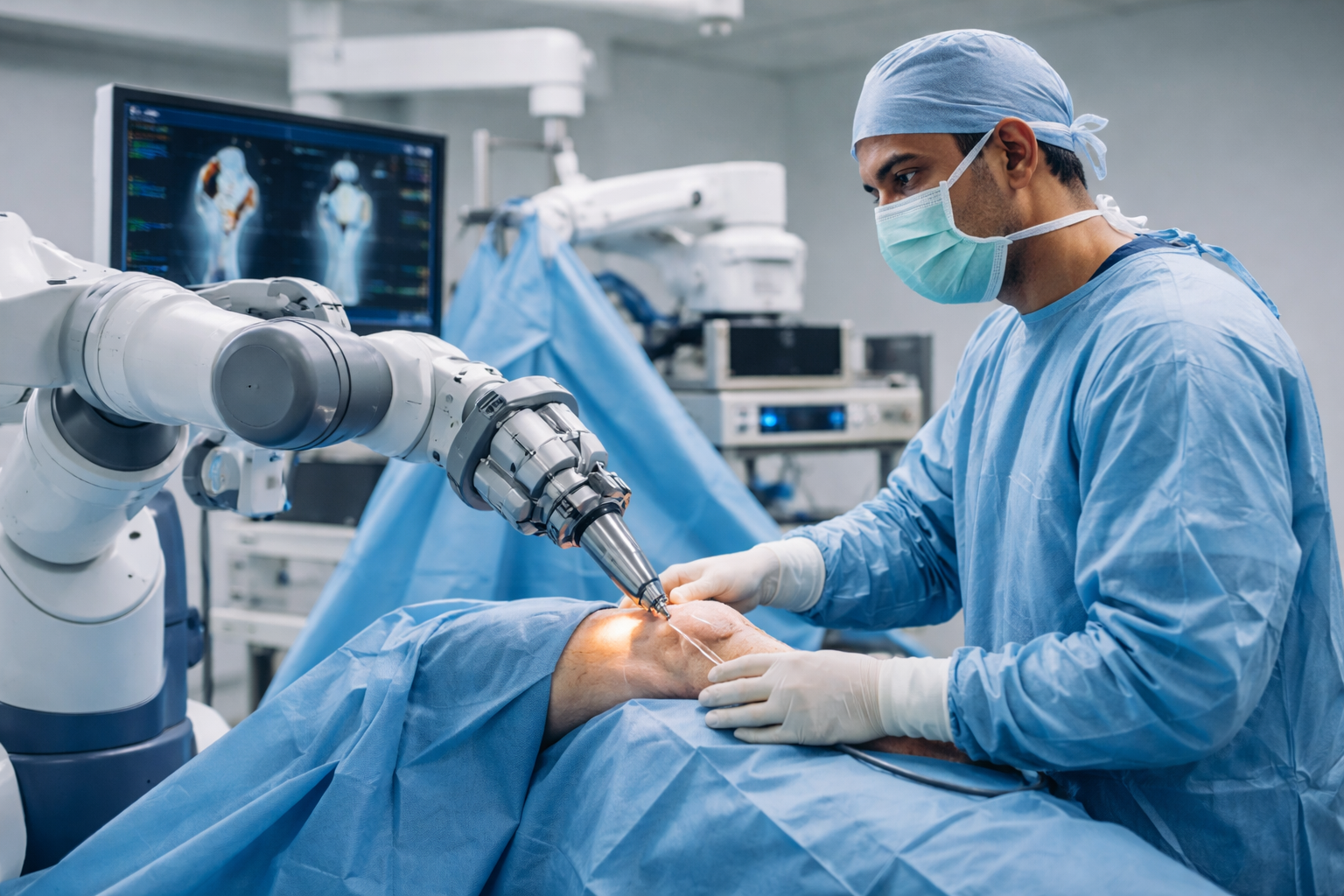
Dr. Abhay Chhallani conducts orthopedic robotic knee surgery under the skilled supervision of the doctor and concentrating on the precise, planned, and compassionate management of the patient. The surgery of the robotic knee replacement eyes is not merely just a replacement of a damaged knee joint. It concerns the ability to restore mobility, enhance stability as well as assist the patients to be in control of their lives again.
Total knee replacement robotic surgery involves the use of computers to aid surgery with the use of surgical expertise, which has been improved through robotic total knee replacement. It is a contemporary technique that enhances the positioning of the implants, the balance of the joint, and stability.
Understanding Knee Arthritis and Joint Degeneration
The knee joint carries most of the body’s weight. It allows bending, straightening, walking, sitting, and climbing. Over time, due to aging, injury, obesity, or inflammatory conditions, the protective cartilage inside the joint begins to wear away.
When cartilage deteriorates:
- Bones rub against each other
- Inflammation increases
- Swelling develops
- Joint space narrows
- Pain intensifies
Patients often experience:
- Persistent knee pain
- Morning stiffness
- Difficulty bending or straightening the knee
- Clicking or grinding sensations
- Reduced walking distance
- Deformity such as bow legs
Emotionally, chronic knee pain can create frustration and dependency. Many patients stop attending social events, reduce travel, and avoid activities they once enjoyed.
In early stages, non surgical treatment such as physiotherapy, medications, strengthening exercises, lifestyle modification, knee braces, and injections may help manage symptoms. However, when arthritis becomes advanced and pain limits daily activities, robotic knee replacement surgery becomes the most reliable long-term solution.
What is Robotic Knee Replacement Surgery?
Robotic knee replacement surgery is a technological aid of knee replacement surgery in which the surgeon is aided by the digital technology to increase precision.
In robotic surgery of total knee replacement, there is a preliminary procedure of an advanced imaging to form a three dimensional image of the knee. This allows:
- Personalized surgical planning
- Accurate implant size selection
- Detailed bone mapping
- Ligament balance assessment
- Simulation of joint movement
In robotic knee surgery, the robotic system can be used to aid in the execution of planned surgical procedure at a high degree of accuracy. The surgeon is fully in charge of the operation. The robotic system helps in improving accuracy and eliminating deviation of the intended position.
Robotic orthopedic knee surgery enhances the uniformity and minimizes the chances of misalignment, which may affect the durability of the implants.
Benefits of Robotic Knee Surgery
Robotic knee surgery offers several important advantages:
Enhanced Surgical Precision
The robotic system helps achieve accurate bone cuts and implant positioning.
Improved Joint Alignment
Proper alignment reduces uneven pressure on the implant and enhances longevity.
Better Ligament Balancing
Balanced ligaments improve knee stability and natural movement.
Reduced Soft Tissue Trauma
Precise planning protects surrounding tissues.
Long-Term Implant Durability
Correct alignment contributes to longer implant life.
Types of Robotic Knee Replacement
The types of robotic knee replacement are chosen based on the patient’s joint condition.
Robotic Total Knee Replacement
Robotic total knee replacement involves replacing the entire damaged joint surface. It is ideal for advanced arthritis affecting all compartments of the knee.
Robotic Partial Knee Replacement
If damage is limited to one part of the knee, partial robotic knee replacement preserves healthy bone and ligaments.
Robotic Bilateral Knee Replacement
When both knees are severely affected, bilateral robotic knee replacement surgery may be recommended.
Revision Robotic Knee Replacement
In cases where a previous implant has failed, revision total knee replacement robotic surgery ensures improved alignment and correction.
Understanding the types of robotic knee replacement allows patients to make informed decisions based on their condition.
Comprehensive Knee Care Services
Dr. Abhay Chhallani provides complete orthopedic care including:
Non Surgical Treatment
- Physiotherapy programs
- Strengthening exercises
- Weight management advice
- Injection therapy
- Pain management
Robotic Total Knee Replacement (TKR)
Precision-guided full joint replacement using robotic assistance.
Minimally Invasive TKR
Smaller incision approach with careful tissue handling.
Arthroscopic ACL Reconstruction
Minimally invasive treatment for ligament injuries.
Who Should Consider Robotic Knee Replacement?
You may be a candidate for robotic knee replacement surgery if:
- Knee pain persists for several years
- Walking distance is reduced
- Night pain disrupts sleep
- Deformity develops
- Non surgical treatment fails
Patients searching online for robotic knee replacement surgeons near me often seek experienced specialists who combine technology with expertise.
The Surgical Process Explained
Pre-Surgical Evaluation
- Clinical examination
- Imaging studies
- Fitness assessment
- Surgical planning
During Surgery
- Robotic mapping verification
- Precision bone preparation
- Implant placement
- Ligament balance testing
Post-Surgical Care
- Early mobilization
- Pain control
- Physiotherapy
- Follow-up monitoring
Most patients begin walking with assistance within 24 hours. Recovery continues with structured physiotherapy to improve strength and flexibility.
Recovery After Robotic Knee Replacement Surgery
Recovery is gradual and guided.
First few days:
- Assisted walking
- Swelling control
- Basic knee bending exercises
First few weeks:
- Strengthening exercises
- Improved range of motion
- Increased walking distance
Long-term recovery:
- Return to daily activities
- Improved stair climbing ability
Better joint confidence
Cost of Robotic Knee Replacement
Many patients want to understand robotic knee replacement cost before deciding.
Robotic knee replacement surgery cost depends on:
- Implant type
- Single or bilateral procedure
- Hospital infrastructure
- Patient’s overall health
Total knee replacement robotic surgery cost reflects advanced technology and precision tools used during surgery. While robotic knee replacement cost may vary, the long-term benefits of improved alignment and durability are important considerations.
Patients receive clear consultation regarding robotic knee replacement cost and insurance coverage.
Long-Term Outcomes
With proper alignment and structured rehabilitation:
- Implants may last 15–20 years or more
- Pain significantly reduces
- Mobility improves
- Quality of life increases
Maintaining a healthy lifestyle after robotic total knee replacement supports long-term results.
Why Patients Trust Dr. Abhay Chhallani
Dr. Abhay Chhallani focuses on patient education, personalized planning, and ethical medical practice.
Patients appreciate:
- Clear explanation of robotic knee replacement surgery
- Honest advice regarding non surgical treatment
- Advanced orthopedic robotic knee surgery expertise
- Structured rehabilitation support
- Transparent communication
The focus is not just surgery, but restoring independence and confidence.
Robotic Knee Replacement in Navi Mumbai – A Modern Solution with Human Care
Robotic knee replacement in Navi Mumbai has transformed joint replacement care. Patients from Nerul, Vashi, Panvel, and Mumbai now have access to advanced robotic knee surgery closer to home.
This modern treatment combines:
- Precision technology
- Surgical expertise
- Structured recovery
- Compassionate patient care
If knee pain is limiting your lifestyle, robotic knee replacement surgery offers a safe, advanced, and reliable solution.
The goal is simple – to help you move comfortably, live actively, and enjoy life without constant knee pain.
Book an Appointment for Robotic Knee Surgery
Frequently Asked Questions About Robotic Knee Replacement
What is the cost of robotic knee replacement in Navi Mumbai?
The robotic knee replacement cost in Navi Mumbai usually depends on hospital type, implant brand, and patient condition. For exact robotic total knee replacement cost, a personal consultation with an orthopedic robotic knee surgery specialist is recommended.
Is robotic knee replacement better than traditional knee replacement?
Yes, robotic knee replacement surgery offers better precision, improved implant alignment, less tissue damage, and potentially faster recovery compared to traditional knee replacement surgery.
How long does recovery take after robotic knee replacement?
Recovery after robotic knee surgery usually takes 6 to 12 weeks. Most patients start walking within 2–3 days after robotic total knee replacement.
Is robotic knee replacement safe?
Yes, robotic knee replacement is safe when performed by an experienced orthopedic robotic knee surgeon using advanced robotic technology in a certified hospital.
How long does a robotic knee replacement last?
A robotic total knee replacement implant can last 15–25 years depending on patient lifestyle, weight management, and post-surgery care.
Can both knees be replaced with robotic surgery?
Yes, bilateral robotic knee replacement surgery can be done either simultaneously or in stages depending on the patient’s medical condition.